
About This Worksheet
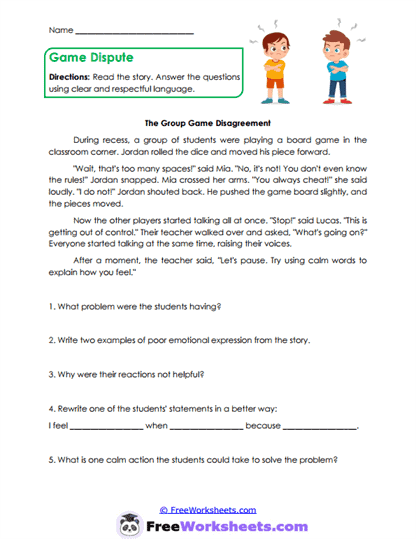
This worksheet uses a short story about a classroom board game to show how poor emotional expression can turn a small disagreement into a larger conflict. Mia snaps at Jordan, Jordan raises his voice, and another student pushes the game and knocks pieces over. Students identify the main problem, find examples of unhelpful reactions, and explain why those responses do not solve the disagreement. They then rewrite one statement with an “I feel…when…because…” sentence and suggest a calm action the group could take.
Skills Developed
Students build reading comprehension, conflict-resolution skills, emotional awareness, and respectful communication. They learn to notice how interrupting, shouting, accusing, and pushing can make a simple disagreement harder to solve. The worksheet also helps them practice moving from blame toward clear feeling language and shared problem-solving. These skills are especially useful during games, recess, partner work, and any activity where children must wait, take turns, and follow agreed-upon rules.
Grade & Stage Appropriateness
This worksheet is most appropriate for elementary students in grades 2 through 5. Children in this range often understand the basic rules of fairness but may still struggle when they feel cheated, interrupted, or ignored. Younger students may need the story read aloud and support identifying the emotional clues, while older students can give more detailed explanations and solutions. The activity is especially helpful for students who become competitive or reactive when plans do not go the way they expected.
Connections to Collaborative for Academic, Social and Emotional Learning (CASEL)
This worksheet aligns strongly with the CASEL areas of self-management, relationship skills, social awareness, and responsible decision-making. Students think about how each person’s reaction affects the group and practice choosing words that make a solution more likely. When I have used game-based conflict stories, children usually recognize the unfair behavior quickly but need more help seeing how yelling and pushing add a second problem. I remind them that solving the rule disagreement becomes much easier once everyone slows down and speaks respectfully.
Using This Worksheet
Teachers can use this story before classroom games, indoor recess, cooperative learning, or any activity that depends on turn-taking. It works well to pause after each outburst and ask what a calmer response could have sounded like. Parents and homeschool educators can connect the story to sibling games, sports, and family activities where arguments sometimes happen. After the worksheet, have the child practice one sentence that calmly explains a fairness concern without blaming or shouting.