
About This Worksheet
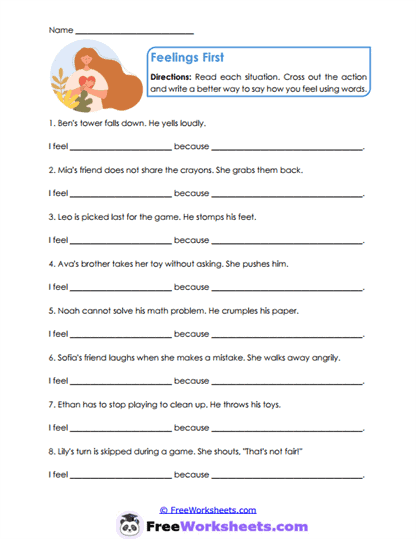
This worksheet teaches children to pause and name an emotion before reacting with yelling, grabbing, pushing, stomping, or throwing. Students read eight familiar situations, cross out the unhelpful action, and complete an “I feel…because…” statement that explains the emotion and its cause. The examples include broken objects, sharing problems, losing a game, frustration with schoolwork, and feeling treated unfairly. This gives children a simple but powerful message: the feeling is allowed, but the first reaction may need to change.
Skills Developed
Students build emotional vocabulary, self-awareness, cause-and-effect thinking, and calmer communication. They practice separating an emotion from the behavior that follows it, which helps them understand that feeling angry is different from pushing someone or throwing an object. The repeated sentence frame also teaches children to explain what happened without blaming or attacking another person. With practice, this language can help students ask for support before a small problem grows into a larger conflict.
Grade & Stage Appropriateness
This worksheet is best suited for early and upper elementary students, especially grades 1 through 4. Younger children are often able to recognize that a behavior is unhelpful before they can clearly explain the feeling underneath it, so the sentence frame offers useful support. Older elementary students can use more exact emotion words and provide fuller reasons for their responses. The activity is especially appropriate for children who are still learning impulse control, frustration tolerance, and safe ways to express disappointment.
Connections to Collaborative for Academic, Social and Emotional Learning (CASEL)
This worksheet connects strongly with the CASEL areas of self-awareness, self-management, and relationship skills. Students identify what they feel, notice an impulsive reaction, and replace that reaction with words that another person can understand. When I use an activity like this with children, I remind them that we are not crossing out the feeling; we are only crossing out the action that could hurt someone or make the problem worse. That small distinction usually helps students feel understood while still learning that they are responsible for how they respond.
Using This Worksheet
Teachers can use this page during a beginning SEL lesson about naming feelings, making safe choices, or using words instead of actions. It works well to model the first situation aloud by naming a possible feeling and explaining why the original behavior would not solve the problem. Parents and homeschool educators can connect the examples to real moments involving toys, games, homework, or siblings. Encourage the child to practice saying each completed sentence in a calm voice so the written response begins to feel like language they could actually use.