
About This Worksheet
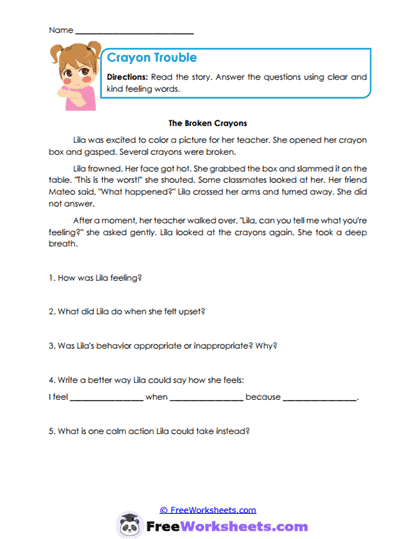
This worksheet uses a short story about broken crayons to help children examine how emotions can lead to unhelpful actions. Lila becomes upset, slams the crayon box, gasps, crosses her arms, and refuses to answer her friend. Students identify how she feels, describe what she does, and decide whether her reaction is appropriate. They then write a better feeling statement and choose a calming action she could use instead.
Skills Developed
Students build reading comprehension, emotional awareness, behavior reflection, and problem-solving skills. They practice using story clues to identify frustration or disappointment and then separate Lila’s feeling from the way she expresses it. The worksheet also teaches children to replace shutdowns or angry actions with clear language and a calming strategy. This helps students understand that emotions are acceptable even when the first reaction needs to change.
Grade & Stage Appropriateness
This worksheet is most appropriate for early and upper elementary students, especially grades 1 through 4. The short story and direct questions are accessible to younger readers, while the reflection and rewriting tasks provide enough depth for older elementary students. Children who need extra support may benefit from hearing the passage read aloud and choosing from a small list of calming strategies. The activity is especially helpful for students learning how to handle broken items, mistakes, disappointment, and sudden frustration.
Connections to Collaborative for Academic, Social and Emotional Learning (CASEL)
This activity supports the CASEL areas of self-awareness, self-management, responsible decision-making, and relationship skills. Students notice Lila’s emotion, examine the result of her behavior, and choose a safer response that would help her communicate with Mateo. In my experience, children understand this story because small disappointments can feel very large in the moment. I remind them that taking a breath does not make the problem disappear, but it gives the brain enough time to choose words instead of an action that may make things worse.
Using This Worksheet
Teachers can read the story aloud and pause when Lila discovers the broken crayons to ask students what her body and face might be doing. After completing the questions, students can role-play a calm response using the provided sentence frame. Parents and homeschool educators can connect the story to broken toys, spilled drinks, lost games, or other familiar frustrations. Help the child select one calming action they can realistically use, such as breathing slowly, asking for help, or taking a brief pause.