
About This Worksheet
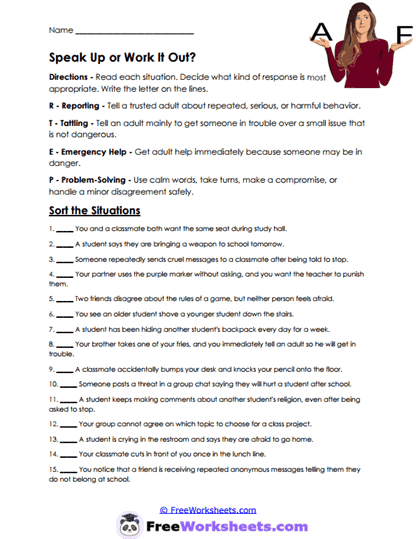
This worksheet helps students decide what kind of response fits different school and peer problems. Children sort fifteen situations into reporting, tattling, emergency help, or problem-solving. The examples include minor annoyances, repeated harassment, threats, injuries, unfair behavior, and disagreements that may be solved calmly. By comparing these situations, students learn that asking for adult help is not always tattling and that some problems require immediate action.
Skills Developed
Students develop safety awareness, judgment, conflict resolution, and responsible help-seeking. They practice noticing the seriousness of a situation, whether the harm is repeated, and whether someone may be in danger. The worksheet also teaches children when they can use calm words or compromise and when an adult needs to become involved. This clearer decision-making can reduce both unnecessary reporting and dangerous silence.
Grade & Stage Appropriateness
This worksheet is best suited for upper elementary through early middle school students, especially grades 4 through 7. Children in this range are expected to solve some small problems independently, but they still need clear guidance about threats, bullying, injuries, and emergencies. Younger students may benefit from reading the situations aloud and discussing the clues, while older students can explain why one response is safer than another. The wide range of examples makes the activity useful for classroom, playground, hallway, bus, and online situations.
Connections to Collaborative for Academic, Social and Emotional Learning (CASEL)
This activity aligns strongly with the CASEL areas of responsible decision-making, self-management, relationship skills, and social awareness. Students pause, judge the level of risk, and choose a response that protects safety without overreacting to small problems. When I use a worksheet like this, students often worry that reporting will make them look like a tattletale. I explain that tattling usually tries to get someone in trouble, while reporting is meant to stop harm, protect safety, or get help for a problem that students cannot solve alone.
Using This Worksheet
Teachers can use this page when reviewing school safety procedures, classroom problem-solving steps, or bullying-reporting expectations. It is helpful to complete a few examples together and ask what detail changes the correct response, such as repetition, danger, or the need for immediate medical help. Parents and homeschool educators can connect the categories to real situations their child may face and practice what they would say to an adult. End the activity by naming several trusted adults the child can approach when a situation feels unsafe or too difficult to manage.