
About This Worksheet
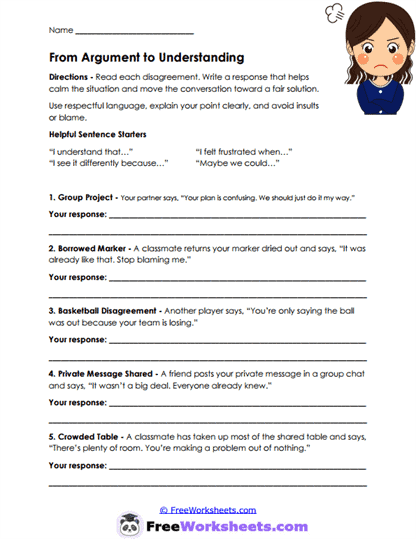
This worksheet helps students move a disagreement away from blame and toward a fair solution. Children read five situations involving group work, borrowed supplies, sports disagreements, private messages, and shared spaces, then write a calm response using respectful sentence starters. The page teaches students that they can disagree, explain their point of view, and protect a boundary without insulting the other person. It also gives them practical language for moments when emotions are strong and the right words may be hard to find.
Skills Developed
Students practice conflict resolution, assertive communication, perspective-taking, and emotional control. They learn how to describe a problem clearly, use “I” statements, listen to another point of view, and suggest a next step. The activity also helps children separate the person from the problem, which can keep a disagreement from turning into name-calling or bullying. These skills are useful during group projects, games, friendships, online conversations, and everyday classroom conflicts.
Grade & Stage Appropriateness
This worksheet is best suited for upper elementary through middle school students, especially grades 4 through 8. Students in this range are handling more peer disagreements independently but may still react with blame, sarcasm, or withdrawal when they feel frustrated. Younger learners can use the sentence starters with adult support, while older students can write fuller responses and discuss compromise, boundaries, and privacy. The situations are realistic enough to feel familiar without being too emotionally intense for a classroom lesson.
Connections to Collaborative for Academic, Social and Emotional Learning (CASEL)
This activity connects closely with the CASEL areas of relationship skills, self-management, social awareness, and responsible decision-making. Students pause before reacting, consider another person’s viewpoint, and choose language that makes a solution more likely. When I use a worksheet like this, I remind students that calm communication does not mean giving up their side of the problem. It means saying what matters in a way that gives both people a chance to listen, respond, and repair the situation.
Using This Worksheet
Teachers can use this page before group work, after a minor classroom conflict, or during a lesson about respectful disagreement. It works especially well when the first situation is modeled aloud so students can hear the difference between a blaming response and a problem-solving response. Parents and homeschool educators can connect the examples to sibling arguments, sports, shared belongings, or digital communication. Encourage children to read their answers aloud and decide whether the response sounds calm, clear, respectful, and likely to help.