
About This Worksheet
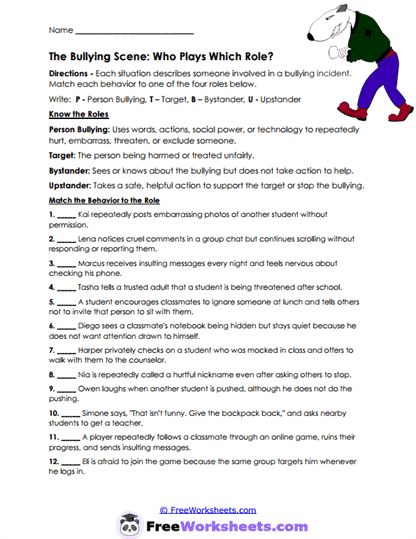
This worksheet helps children understand the four common roles that may appear in a bullying situation: the person bullying, the target, the bystander, and the upstander. Students first read clear definitions and then match twelve behaviors with the correct role. The examples include spreading embarrassing photos, receiving repeated cruel messages, ignoring harmful behavior, seeking help from an adult, and standing beside a student who has been excluded. The activity shows that bullying affects more people than only the child causing harm and the child being targeted.
Skills Developed
Students develop social awareness, empathy, and personal responsibility as they study how different people contribute to or interrupt harmful behavior. They learn that a bystander sees what is happening but does not act, while an upstander chooses a safe way to offer support or get help. The worksheet also helps children recognize less obvious forms of bullying, including online harassment, exclusion, rumors, and repeated name-calling. By examining each role, students can begin thinking about the role they want to choose when they witness harm.
Grade & Stage Appropriateness
This worksheet is appropriate for upper elementary and middle school students, generally grades 4 through 8. Students at these levels are increasingly influenced by peer groups and may witness bullying without knowing whether or how to respond. The clear matching format makes the activity accessible to younger learners, while the online and social examples remain meaningful for older students. It is particularly helpful for classes that are learning how individual choices can either strengthen harmful group behavior or help stop it.
Connections to Collaborative for Academic, Social and Emotional Learning (CASEL)
This worksheet aligns closely with the CASEL areas of social awareness, relationship skills, and responsible decision-making. Children practice recognizing another person’s pain, understanding group behavior, and considering safe ways to support someone who is being mistreated. In my experience, students often believe they must confront the person bullying in order to be an upstander, which can feel frightening or unsafe. I use this lesson to show that getting a trusted adult, staying with the target, saving evidence, or refusing to join in are all meaningful and responsible actions.
Using This Worksheet
Teachers can use this activity to introduce bullying roles before students practice specific upstander responses. After matching the examples, the class can discuss which upstander actions feel safest in different settings, including school hallways, group chats, games, and transportation. Parents and homeschool educators can ask children which role is easiest to recognize and which one is hardest. Keep the conversation focused on future choices rather than asking children to publicly name classmates who may fit the roles.