
About This Worksheet
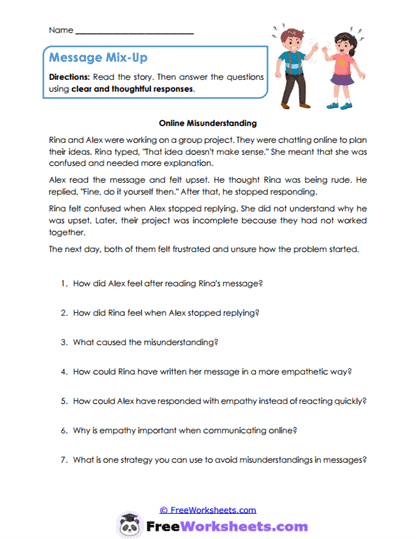
This worksheet uses a short story about a confusing online message to show how easily tone can be misunderstood in digital communication. Rina writes that Alex’s idea does not make sense, Alex assumes she is being rude, and both students stop communicating before the real meaning is explained. Students examine each character’s feelings, identify the cause of the misunderstanding, and rewrite both responses in a more empathetic way. The story teaches that typed words do not include facial expressions or tone of voice, so clear and caring language becomes especially important.
Skills Developed
Students strengthen digital citizenship, perspective-taking, emotional reasoning, and conflict-resolution skills. They practice considering more than one interpretation of a message instead of reacting to the most negative possibility. The worksheet also encourages students to ask for clarification, explain their meaning calmly, and avoid disappearing from a conversation without addressing the problem. These skills can reduce unnecessary conflict in group chats, shared documents, games, and online schoolwork.
Grade & Stage Appropriateness
This worksheet is best suited for upper elementary through middle school students, especially grades 5 through 8. Students in this range are using digital communication more often and may be especially sensitive to brief messages that sound critical or unfriendly. Younger learners may need help understanding how tone gets lost in writing, while older students can discuss assumptions, response time, punctuation, and the risks of reacting too quickly. The activity is especially useful for students who communicate frequently through texts, chats, or collaborative online platforms.
Connections to Collaborative for Academic, Social and Emotional Learning (CASEL)
This worksheet aligns closely with the CASEL areas of social awareness, relationship skills, self-management, and responsible decision-making. Students pause before reacting, consider the other person’s intention, and choose language that supports clarification rather than blame. When I use stories like this, I tell students that online empathy often begins with giving the other person a little room for misunderstanding. A question such as “Could you explain what you mean?” can prevent a small confusing message from becoming a much larger conflict.
Using This Worksheet
Teachers can use this page during a digital citizenship lesson, online group-work preparation, or discussion about tone in messages. It works well to compare how the same sentence may sound friendly, neutral, or rude depending on imagined tone. Parents and homeschool educators can connect the story to texts, gaming chats, and messages between friends. After completing the questions, encourage students to create one simple rule for themselves, such as asking for clarification before assuming someone meant to be hurtful.