
About This Worksheet
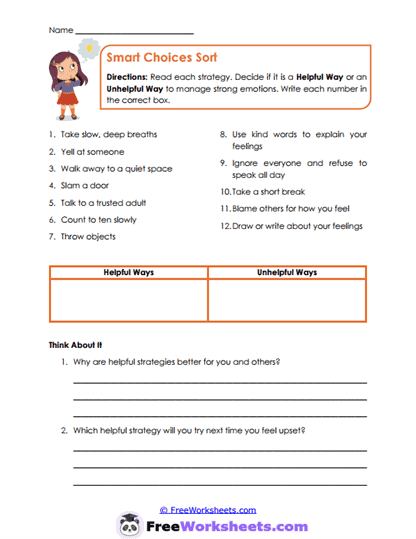
This worksheet helps students tell the difference between helpful and unhelpful ways of managing strong emotions. Children sort twelve strategies into two groups, including deep breathing, talking to an adult, counting slowly, blaming others, slamming a door, drawing, and walking to a quiet space. The follow-up questions ask why helpful strategies are better for everyone involved and which one the student might try next time. This makes the activity more than a simple sort because children also connect the choices to their own emotional needs.
Skills Developed
Students strengthen coping awareness, decision-making, emotional regulation, and personal reflection. They learn that helpful strategies calm the body, communicate needs, or create enough space to make a better decision, while unhelpful reactions often increase harm or keep the problem going. The worksheet also gives children a menu of practical coping choices instead of expecting them to think of a strategy while already upset. Choosing one strategy to try builds ownership and makes the lesson easier to apply in real situations.
Grade & Stage Appropriateness
This worksheet is best suited for elementary students in grades 1 through 5. The sorting format is accessible for younger children, while the written reflection questions provide a meaningful challenge for older students. Early learners may need the strategies read aloud and demonstrated, while more advanced students can explain when each helpful strategy would work best. The activity is especially useful for children who know they need to calm down but are unsure what they can actually do.
Connections to Collaborative for Academic, Social and Emotional Learning (CASEL)
This worksheet strongly supports the CASEL areas of self-management, self-awareness, and responsible decision-making. Students examine different coping choices, consider their likely effects, and select a strategy that can help them respond safely. When I use strategy-sorting activities, I remind children that one calming tool may not work in every situation or for every person. The goal is to build a small collection of helpful choices so they can try another strategy when the first one does not bring enough calm.
Using This Worksheet
Teachers can use this page to introduce a classroom calming area, review coping tools, or prepare students for emotionally challenging situations. It works well to demonstrate several strategies, such as slow breathing, counting, or asking for a break, before students complete the sort. Parents and homeschool educators can circle two or three choices that are practical at home and practice them during calm moments. Displaying the selected strategies somewhere visible can help children remember them before emotions become too strong.