
About This Worksheet
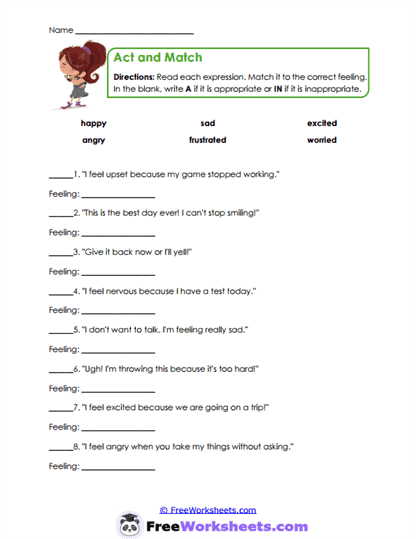
This worksheet helps students connect emotional words with the actions and statements that show those feelings. Children read eight short expressions, identify the feeling being shown, and decide whether the response is an appropriate or inappropriate way to communicate it. The examples include smiling with excitement, speaking about sadness, yelling in anger, throwing an object in frustration, and snapping when someone takes a belonging. This makes the page useful for showing that the same emotion can be expressed in either a safe way or a harmful way.
Skills Developed
Students strengthen emotion recognition, behavior awareness, reading comprehension, and responsible decision-making. They practice using clues from tone, word choice, and actions to decide whether someone feels happy, sad, angry, excited, frustrated, or worried. The worksheet also helps children separate the emotion from the behavior, since feeling angry is understandable while threatening or throwing may still be inappropriate. This is an important step in helping students notice their own reactions before those reactions become bigger problems.
Grade & Stage Appropriateness
This worksheet is best suited for early and upper elementary students, especially grades 1 through 4. Younger learners can match the most obvious expressions with basic emotion words, while older students can explain why a response is helpful or unhelpful. The short examples make the activity manageable for developing readers, and the behavior judgment adds a deeper social-emotional layer. It is especially useful for children who are still learning how facial expressions, words, and actions communicate feelings to other people.
Connections to Collaborative for Academic, Social and Emotional Learning (CASEL)
This activity connects closely with the CASEL areas of self-awareness, self-management, and responsible decision-making. Students identify emotions, examine how those emotions are being shown, and decide whether the behavior is safe and respectful. When I use a page like this, I remind children that we are not labeling the feeling as good or bad. We are looking at whether the action helps communicate the feeling or creates more harm.
Using This Worksheet
Teachers can complete the first example aloud and ask students to name both the emotion and the clue that helped them recognize it. After students finish, the class can rewrite each inappropriate response as a safer one while keeping the same feeling. Parents and homeschool educators can connect the examples to familiar moments involving games, tests, trips, and shared belongings. Encourage the child to say one appropriate sentence they could use the next time they feel angry, frustrated, or worried.