
About This Worksheet
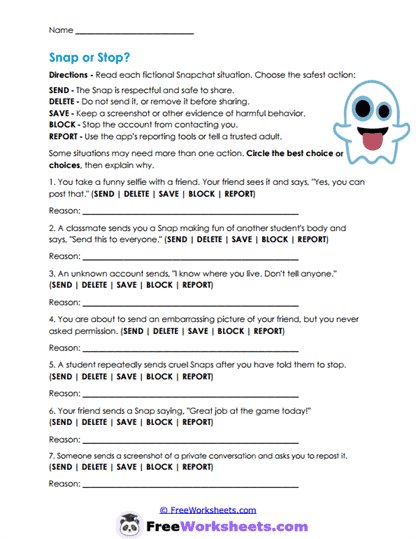
This worksheet helps students make safer choices when using Snapchat or similar messaging apps. Children read seven fictional situations involving selfies, body-shaming, threats, embarrassing pictures, repeated unwanted messages, positive posts, and private screenshots. For each example, they choose whether to send, delete, save, block, or report the content, then explain their reason. The activity shows students that digital safety is not only about what they post themselves, but also how they respond when someone else sends something harmful, private, or uncomfortable.
Skills Developed
Students strengthen digital citizenship, privacy awareness, personal safety, and responsible decision-making. They practice recognizing warning signs such as repeated harassment, threats, humiliation, unwanted contact, and sharing private conversations without permission. The worksheet also teaches that different situations call for different actions, since a kind message may be safe to send while threatening or repeated harmful content should be saved and reported. These skills help children move beyond reacting quickly and begin choosing responses that protect both themselves and others.
Grade & Stage Appropriateness
This worksheet is best suited for upper elementary through middle school students, especially grades 5 through 8. Children in this age range may be gaining access to disappearing-message apps, group chats, and direct messaging, even if their use is still supervised. Younger students may need adults to explain why saving harmful content can be important evidence, while older students can discuss blocking, reporting, privacy, and the limits of disappearing messages. The worksheet is especially useful before students begin using social apps more independently.
Connections to Collaborative for Academic, Social and Emotional Learning (CASEL)
This activity connects strongly with the CASEL areas of responsible decision-making, self-management, social awareness, and relationship skills. Students pause before responding, think about possible harm, and choose an action that protects safety and dignity. When I use examples like these with children, I remind them that deleting something from their own screen does not always solve the larger problem. Saving evidence, blocking contact, and telling a trusted adult can be important when messages are threatening, repeated, humiliating, or deeply personal.
Using This Worksheet
Teachers can use this page during a digital citizenship unit, cyberbullying lesson, or classroom discussion about privacy and online boundaries. It works well to review the action choices first so students understand when each one may be appropriate. Parents and homeschool educators can use the situations to talk about the child’s actual apps, privacy settings, and trusted adults. Encourage children to explain not only what action they would take, but also why that choice would make the situation safer.