
About This Worksheet
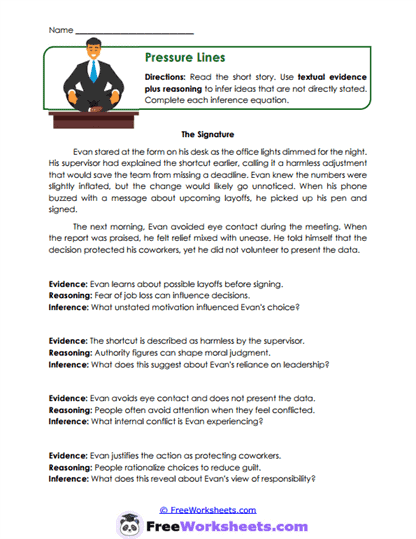
Pressure Lines is a grade 11 literary analysis worksheet focused on inference, ethical tension, and internal conflict. It is a high school literacy resource designed to strengthen students’ ability to move beyond explicit statements and analyze motivations that are implied through actions, omissions, and subtle narrative details. The short story, The Signature, centers on a character who signs off on questionable data after learning about potential layoffs. Rather than stating his fear directly, the text reveals it through small choices-avoiding eye contact, justifying his actions internally, and describing relief mixed with unease. This worksheet builds higher-level interpretive skills by requiring students to connect textual evidence with psychological reasoning.
Curriculum and Grade Alignment
This worksheet is designed for Grade 11 and emphasizes citing strong and thorough textual evidence to support inferences about character motivation and ethical conflict. The primary learning goal is to analyze how implicit details reveal internal struggle. Students should already be comfortable identifying explicit character actions before evaluating subtext and moral ambiguity. The next progression skill involves writing literary analysis essays that examine how authors develop ethical themes through subtle narrative cues. This resource aligns with CCSS.ELA-LITERACY.RL.11-12.1 and RL.11-12.3.
Student Tasks
Students examine four evidence-reasoning pairs drawn from the story. For each, they complete an inference equation that moves from evidence and reasoning to a deeper interpretation about Evan’s motivations, beliefs about leadership, or sense of responsibility. Learners must explain how fear of job loss, authority pressure, or guilt influences his decision-making. Each response requires direct reference to textual details and logical reasoning beyond summary.
Common Challenges and Misconceptions
Students may restate the evidence rather than extending it into interpretation. Some learners might focus only on plot events instead of analyzing internal conflict. Others may assume a single motivation rather than recognizing layered pressures. Teachers can model how to transform evidence into a claim about character psychology.
Implementation Guidance
This worksheet works well in units focused on ethical dilemmas, workplace narratives, or moral decision-making in literature. Teachers can extend the activity by asking students to write a short reflection from Evan’s perspective. Small-group discussions can compare competing interpretations of his motives.
Details and Features
The worksheet includes a compact narrative with structured inference prompts. Questions scaffold from concrete evidence to abstract reasoning. The layout supports paragraph-length analytical responses. The printable format is classroom-ready and encourages deep textual engagement.