
About This Worksheet
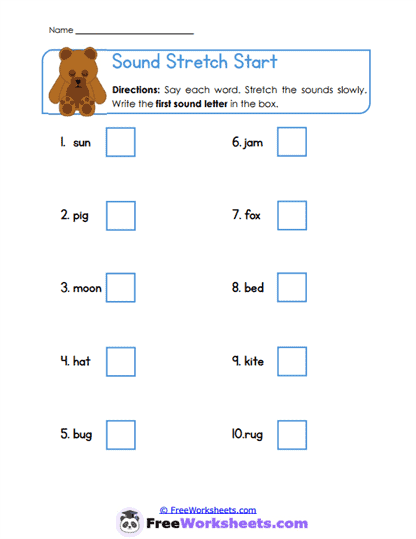
This worksheet helps preschool students hear and identify beginning letter sounds in simple words. Beginning sound practice is an important early reading skill that teaches children how spoken sounds connect to printed letters. Students slowly say each word aloud and write the first sound letter inside the box. For example, the word sun becomes the letter S because /s/ is the first sound heard. This activity supports phonemic awareness, early spelling development, and letter-sound recognition skills.
Curriculum and Grade Alignment
This preschool literacy worksheet focuses on phonics and early spelling foundations. Children practice listening carefully for the first sound in a word and matching that sound to a letter. Before using this worksheet, students should recognize several uppercase and lowercase letters and understand basic letter sounds. Future literacy learning will include blending sounds together to read and spell complete words. This activity aligns with CCSS.ELA-LITERACY.RF.K.2.D and TEKS standards related to phonological awareness and letter-sound correspondence.
Student Tasks
On this worksheet, students will say simple words aloud and stretch out the beginning sound they hear. Learners listen carefully to words like pig, moon, fox, and rug before deciding which letter belongs in the box. Children write the correct beginning letter beside each picture word. Students practice connecting spoken sounds to printed letters while building confidence in early writing skills. The activity also encourages children to slow down and listen closely to speech sounds.
Common Challenges and Misconceptions
Some preschool students may confuse letter names with letter sounds while completing the activity. Children sometimes hear the ending sound more strongly than the beginning sound and choose the wrong letter. A few learners may struggle with sounds that are close together, such as /b/ and /p/. Others may rush through the words without stretching the sounds slowly enough to hear them clearly. Teachers can help by modeling each word aloud and emphasizing the first sound together.
Implementation Guidance
Teachers can use this worksheet during phonics lessons, literacy centers, or small-group reading instruction. Parents may also use the activity at home to practice sounding out simple words during everyday conversations. Saying the words slowly and clearly can help children feel more successful while learning beginning sounds. Adults can encourage children to repeat sounds several times before writing the answer. This worksheet works well as independent review practice after direct phonics instruction.
Details and Features
This printable worksheet includes simple one-word examples that are familiar and easy for preschool students to understand. Large answer boxes provide enough space for young learners to practice writing letters clearly. The page layout is clean and uncluttered so children can focus on one word at a time without distraction. Bright visuals and readable text help support beginning readers and writers. The worksheet prints clearly for classroom, homeschool, or intervention use.