
About This Worksheet
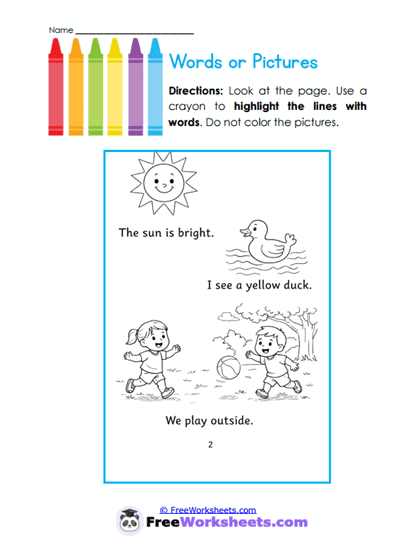
This worksheet helps preschool students identify printed words on a page and distinguish them from pictures. Print awareness activities teach children that words carry meaning and are different from illustrations. Students use a crayon to highlight the lines that contain words while leaving the pictures uncolored. For example, sentences like “The sun is bright” should be highlighted because they are made of words. This activity supports print recognition, visual discrimination, and early reading readiness skills.
Curriculum and Grade Alignment
This preschool literacy worksheet focuses on print awareness and identifying text within a page layout. Children practice recognizing the difference between illustrations and written language. Before beginning this activity, students should understand basic concepts about books and printed text. Future literacy learning may include tracking words while reading and recognizing sentence structures independently. This worksheet aligns with CCSS.ELA-LITERACY.RF.K.1 and TEKS standards related to foundational print concepts.
Student Tasks
On this worksheet, students will study a page that includes both pictures and simple sentences. Learners identify the lines that contain words and highlight only the text using a crayon or marker. Children practice distinguishing printed language from illustrations and decorative elements. Students strengthen visual attention and print awareness while learning how readers focus on words. The activity also encourages careful observation and following directions during literacy instruction.
Common Challenges and Misconceptions
Some preschool students may color the pictures instead of highlighting only the words. Children can also confuse decorative marks or page numbers with sentences. A few learners may rush through the page without carefully identifying each line of text first. Others may need support understanding that words tell the message while pictures support meaning. Teachers can help by modeling how to point to and track printed words before students begin.
Implementation Guidance
Teachers can use this worksheet during print awareness lessons, literacy centers, or guided reading warm-ups. Parents may also use the activity at home while discussing words and pictures in books together. Encouraging children to read or repeat the sentences aloud can strengthen comprehension and vocabulary development. Adults can ask questions like “Which parts are the words?” to reinforce understanding. This worksheet also works well for intervention practice or independent review.
Details and Features
The worksheet includes simple sentences and clear illustrations that are easy for preschool learners to distinguish visually. Highlighting tasks provide interactive practice without requiring advanced writing skills. Large spacing and uncluttered formatting help children focus on print recognition. Familiar vocabulary keeps attention on the literacy skill rather than difficult decoding tasks. The worksheet prints clearly for classroom instruction, homeschool learning, or intervention support.