
About This Worksheet
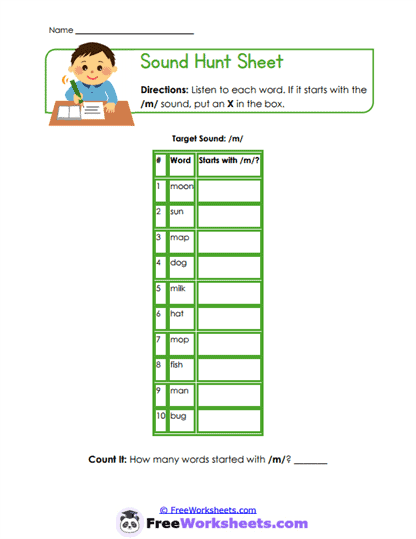
This worksheet teaches preschool students how to listen for a target beginning sound in a group of words. Sound discrimination is an early phonics skill where children hear similarities and differences between spoken words. Students focus on the /m/ sound and decide which words begin with that sound by marking boxes on the chart. For example, the word moon starts with /m/, while the word dog does not. This activity supports phonemic awareness, listening comprehension, and early reading readiness skills.
Curriculum and Grade Alignment
This preschool literacy worksheet focuses on beginning sound recognition and phonological awareness. Children practice listening closely to spoken words and identifying matching sounds within a word list. Before completing this activity, students should understand several alphabet sounds and recognize common vocabulary words. Later literacy instruction may include blending sounds and sorting words into phonics groups independently. This worksheet aligns with CCSS.ELA-LITERACY.RF.K.2.D and TEKS standards related to sound identification and phonics instruction.
Student Tasks
On this worksheet, students will listen to or read simple words like moon, mop, fish, and map. Learners decide whether each word starts with the target /m/ sound and place an X in the matching box if it does. Children count how many words begin with the sound at the end of the activity. Students practice careful listening and comparing sounds while reviewing familiar vocabulary words. The worksheet also encourages children to slow down and think carefully before marking answers.
Common Challenges and Misconceptions
Some preschool students may confuse the letter name with the sound it makes during the activity. Children might also mark words that contain the sound somewhere in the word instead of only at the beginning. A few learners may rush through the list without saying the words aloud carefully. Others may struggle with hearing subtle sound differences between words. Teachers can support understanding by modeling how to stretch the beginning sound slowly before students answer.
Implementation Guidance
Teachers can use this worksheet during phonics lessons, literacy centers, or intervention practice for sound recognition skills. Parents may also use the activity at home as part of alphabet and sound review games. Reading each word aloud together before marking the chart can help children build confidence and accuracy. Adults can encourage learners to repeat the target sound several times before beginning the worksheet. This activity also works well as review after introducing one specific letter sound.
Details and Features
This printable worksheet includes a simple chart format that is easy for preschool students to understand and complete independently. Large text and organized spacing support early learners who are still developing tracking skills. The counting section at the bottom adds an extra layer of thinking and review practice. Familiar one-syllable vocabulary words keep the focus on listening for sounds rather than decoding difficult words. The worksheet prints clearly for classroom instruction, homeschool learning, or intervention support.