
About This Worksheet
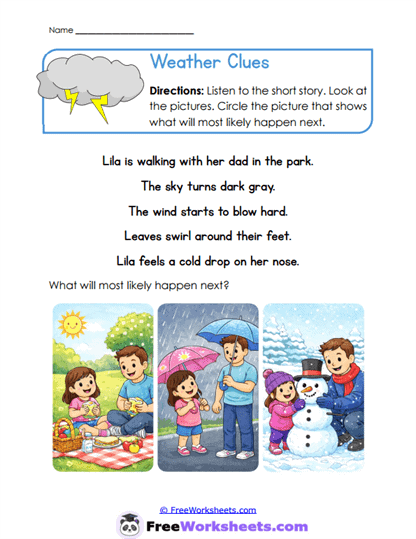
This worksheet teaches preschool students how to use clues in a story to make a simple inference about what will happen next. Inference is a reading skill where children use details they hear or see to figure out information that is not directly stated. Young learners listen to weather clues like dark clouds, strong wind, and cold rain drops, then connect those clues to the most likely outcome. For example, dark gray skies and rain drops become the idea that rain is coming soon. This activity supports early literacy, listening comprehension, and critical thinking skills in a way that feels fun and easy for small children.
Curriculum and Grade Alignment
This preschool literacy worksheet focuses on early comprehension and prediction skills. Children practice listening carefully to details and using those details to make logical choices. Before completing activities like this, students should be able to listen to a short story and recognize basic weather vocabulary. After this skill, children move into stronger reading comprehension tasks where they explain why they made a prediction. This activity aligns with Common Core early literacy standards such as CCSS.ELA-LITERACY.RL.K.1 and TEKS English Language Arts standards related to listening and comprehension.
Student Tasks
On this worksheet, students will listen to or read a short weather story about a girl walking in the park with her father. Children study the pictures shown at the bottom of the page and think about which image matches the story clues best. Learners must decide what will most likely happen next based on the information they were given. Students practice making thoughtful choices instead of guessing randomly. The activity also encourages young children to explain their thinking aloud during discussion time.
Common Challenges and Misconceptions
Some preschool students may choose a picture based only on what they personally like instead of using the story clues. Children might also become distracted by bright or exciting pictures that do not match the passage. A few learners may not fully understand how weather clues connect to future events. Others may struggle to remember details from the short story while looking at the answer choices. Teachers can help by rereading the story slowly and pointing out important clue words together.
Implementation Guidance
Teachers can use this worksheet during whole-group reading lessons, literacy centers, or guided reading time. Parents may also use it at home to practice listening and thinking skills in a relaxed way. Reading the story aloud with expression can help children notice important clues more clearly. Adults can encourage discussion by asking simple questions like “What clues tell us rain is coming?” This worksheet also works well as an independent practice activity after a classroom lesson about weather or predictions.
Details and Features
This printable worksheet includes colorful weather-themed illustrations that are easy for preschool children to understand. The page layout is simple and uncluttered so young learners can focus on the story and pictures. Students answer by circling one image, which keeps the task developmentally appropriate for early learners. The worksheet prints clearly in black and white or color for classroom and homeschool use. Large visuals and readable text help support beginning readers and children learning through listening.