
About This Worksheet
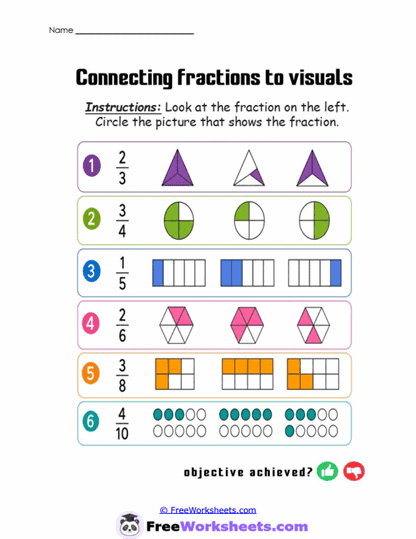
This Grade 4 math worksheet gives children more practice matching fractions to pictures, but the models use a wider range of shapes and arrangements. Students work with fractions including 2/3, 3/4, 1/5, 2/6, 3/8, and 4/10.
Each row gives three possible visual models. Students have to decide which one correctly shows the fraction written at the left. This helps them become less dependent on one familiar shape and more focused on the actual fraction relationship.
Learning Goals
The main goal is to help students recognize fractions no matter how the whole is drawn.
Children practice counting equal parts, identifying shaded sections, and comparing those counts with the numerator and denominator. They also strengthen their understanding that a fraction can be represented with triangles, circles, bars, grids, or groups of objects.
This kind of flexibility is important in Grade 4 because fraction problems are not always shown the same way.
What Students Will Do
Students begin with the fraction in each row and then study the three models beside it.
They count the total equal parts in each picture and compare that count to the denominator. Then they count the shaded parts and compare that to the numerator.
They circle the one model that matches both numbers.
For example, 1/5 must show five equal parts with one shaded. 4/10 must show ten total parts with four shaded.
Common Challenges
Some children may be thrown off when the model is a group of objects instead of one shape divided into sections. The same fraction rule still applies: count all the equal objects, then count how many are shaded.
Others may assume the most shaded-looking picture is correct. Remind them that the fraction is about numbers of equal parts, not just appearance.
Teaching Suggestions
Teachers can have students point to the denominator first and say the total they are looking for. Then they can count the shaded parts and compare them with the numerator.
Parents can use simple language such as, “How many in all? How many colored?” This keeps the process clear and repeatable.
For extra practice, ask the child to draw a new model for one of the fractions after finishing the page.
Worksheet Features
The page includes six rows of visual fraction choices using triangles, circles, rectangles, grids, and grouped objects. The varied models make this a strong review of flexible fraction thinking.
This worksheet fits well in math centers, homework, guided practice, or review before moving into equivalent fractions.