
About This Worksheet
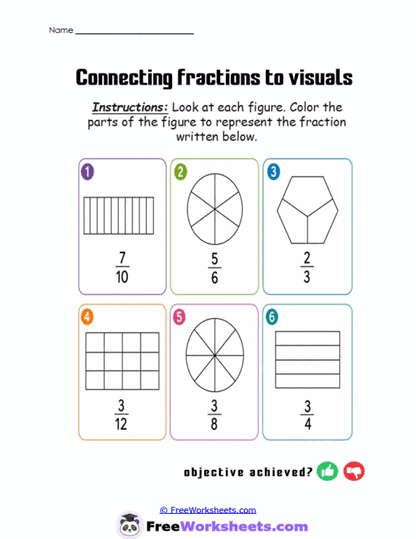
This Grade 4 math worksheet helps children practice showing a written fraction by coloring part of a visual model. Students work with fractions such as 7/10, 5/6, 2/3, 3/12, 3/8, and 3/4. The shapes include rectangles, circles, and a three-part figure, so children have to apply the same fraction idea to several different kinds of pictures.
This is useful because students need to understand that a fraction is not tied to one certain shape. Whether the whole is a circle or a rectangle, the denominator still tells how many equal parts make up the whole, and the numerator still tells how many parts should be shaded.
Learning Goals
The main goal is to help children become more confident reading fractions and turning them into pictures.
Students practice using the bottom number to identify how many equal pieces are in the whole and the top number to decide how many of those pieces to color.
The activity also gives children practice with larger denominators such as 10 and 12, which helps prepare them for comparing fractions and working with equivalent fractions later on.
What Students Will Do
Students complete six fraction models.
For each problem, they first read the fraction written underneath the picture. Then they count the equal sections in the model and make sure that number matches the denominator.
Next, they color the number of parts shown by the numerator.
For example, with 7/10, the whole has 10 equal parts and seven should be colored. With 3/12, there are 12 equal boxes and three should be shaded.
Students repeat this process until every visual correctly shows the fraction underneath it.
Common Challenges
Children may lose count when the model has many small sections. This is especially common with tenths or twelfths.
A parent or teacher can suggest counting in an organized way from left to right instead of jumping around the picture.
Another common mistake is coloring the denominator instead of the numerator. A simple reminder is, “Bottom tells how many there are. Top tells how many to color.”
Teaching Suggestions
Before children begin, have them explain one fraction out loud. Ask, “How many equal parts are there altogether?” and then, “How many will you shade?”
Teachers can also ask students to name the fraction that remains uncolored. If seven tenths are shaded, three tenths remain. This adds a little extra thinking without changing the main task.
For children who need support, lightly mark the sections to be colored before using crayons.
Worksheet Features
The page includes six fraction models with denominators from 3 through 12. The varied shapes give students repeated practice applying the same fraction rule in different visual settings.
This works well for independent math practice, small groups, homework, or fraction review.