
About This Worksheet
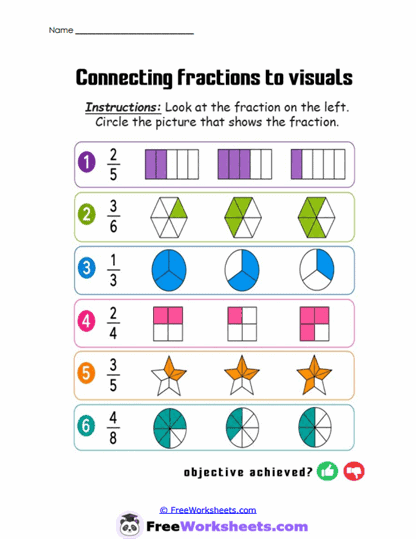
This Grade 4 math worksheet helps children look at a written fraction and decide which visual model shows it correctly. Students work with fractions such as 2/5, 3/6, 1/3, 2/4, 3/5, and 4/8. Each row gives three picture choices, and only one of them matches the fraction on the left.
This is useful because students have to do more than recognize a shaded shape. They need to count the total number of equal parts, count how many are shaded, and then compare that information to the numerator and denominator. That gives them a stronger understanding of what the fraction is really showing.
Learning Goals
The main goal is to help students connect written fractions with visual models accurately.
Children practice using the denominator to identify the total number of equal sections and the numerator to identify how many of those sections should be shaded. They also get extra exposure to fractions that may represent the same amount, such as 3/6 and 4/8.
This supports visual reasoning, fraction sense, and the ability to compare models carefully.
What Students Will Do
Students work through six rows. Each row begins with a fraction and three possible pictures.
They look at each model, count all the equal parts, and then count the shaded sections. After comparing those numbers with the written fraction, they circle the correct picture.
For example, a fraction of 2/5 must show five equal parts with two shaded. A fraction of 4/8 must show eight equal parts with four shaded.
The key is to count the parts instead of guessing by how much of the picture looks colored.
Common Challenges
Some children may focus only on the amount of color and forget to count how many equal pieces make up the whole. Two pictures can look very similar even when one is divided into the wrong number of sections.
A parent or teacher can ask, “How many pieces altogether?” and “How many are colored?” Those two questions usually make the answer clear.
Students may also be confused when different shapes represent the same fraction amount. Remind them that the shape can change, but the fraction relationship stays the same.
Teaching Suggestions
Before starting, model one row together and say the fraction out loud. Then point to the denominator and ask what total number of pieces is needed.
Teachers can also ask students to explain why the other two pictures are wrong. That extra conversation is often more valuable than simply circling the right answer.
For an extension, ask students which fractions on the page are equivalent and how they can tell from the pictures.
Worksheet Features
The page includes six fraction rows with three visual choices in each row. Models include bars, circles, grids, stars, and other shapes, which helps children see fractions in many forms.
This worksheet works well for guided math, independent review, fraction centers, homework, or a quick check of visual fraction understanding.