
About This Worksheet
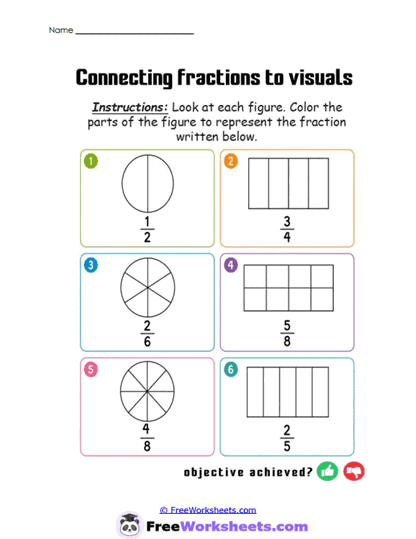
This Grade 4 math worksheet helps children connect a written fraction to a picture by coloring the correct number of equal parts. Students see six different shapes, including circles, rectangles, and grids. Under each shape is a fraction such as 1/2, 3/4, 2/6, 5/8, 4/8, or 2/5.
The activity gives children a very clear way to see what a fraction actually means. Instead of only looking at numbers, they can show the fraction by coloring part of a whole. This is especially helpful for students who understand math better when they can see it.
Learning Goals
The main goal is to help students understand that the denominator tells how many equal parts make up the whole and the numerator tells how many of those parts should be colored.
For example, with 3/4, the shape must be divided into four equal parts, and the child colors three of them. With 2/6, there are six equal parts and two should be shaded.
This visual practice builds a strong foundation for later work with equivalent fractions, comparing fractions, adding fractions, and understanding fractions on number lines.
What Students Will Do
Students work through six fraction models one at a time.
First, they read the fraction written underneath the shape. Next, they count how many equal sections are inside the picture and connect that number to the denominator.
Then they look at the numerator and color exactly that many sections.
Children repeat the process with several different shapes and fraction sizes. Because the pictures are not all divided the same way, students have to pay attention to the fraction each time instead of following one repeated coloring pattern.
Common Challenges
Some children may accidentally reverse the numerator and denominator. They might see 3/4 and think they should color four parts instead of three.
A parent or teacher can use a simple reminder: “The bottom number tells how many pieces there are. The top number tells how many pieces to color.”
Another common mistake is counting the dividing lines instead of the actual sections. Encourage the child to point to each complete piece as they count.
Teaching Suggestions
Before starting, work through one example together. Ask, “How many equal pieces are in the whole?” Then ask, “How many does the fraction tell us to color?”
Try not to tell the child which sections to shade. Any sections can be colored as long as the correct number of equal parts is represented.
Teachers can also ask students to say each fraction aloud after coloring it, such as “three fourths” or “two fifths.” This connects the picture, number, and spoken fraction.
Worksheet Features
The page includes six fraction models using different shapes and divisions. Fractions range from halves and fourths to fifths, sixths, and eighths, giving students a good mix of visual practice.
It works well for introductory fraction lessons, independent math practice, homework, review, or small-group support.