
About This Worksheet
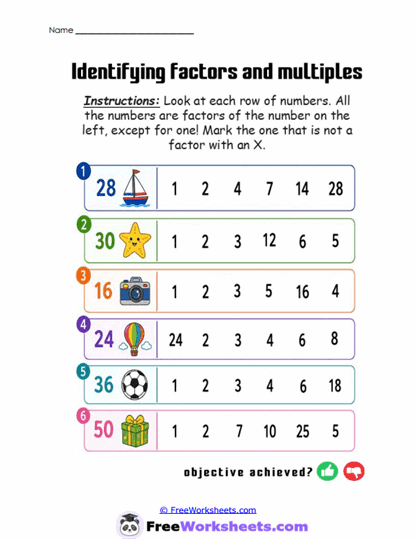
This Grade 4 math worksheet helps children become careful factor checkers. Students work with the target numbers 28, 30, 16, 24, 36, and 50. Beside each target is a list of numbers that looks almost correct, but one number in every row is not actually a factor. Students have to find that mistake and mark it with an X.
This kind of practice is useful because children cannot simply look for numbers they recognize. They have to check the entire list and prove which number does not divide evenly into the target. That builds stronger number sense and teaches students to double-check their math instead of guessing.
Learning Goals
The main goal is to help students identify factors accurately and spot a number that does not belong in a factor list.
Children practice using multiplication facts and division to test factor relationships. They reinforce the idea that a factor must divide the target number exactly, with no remainder.
This skill is important for later work with prime and composite numbers, common factors, fraction simplification, and divisibility.
What Students Will Do
Students begin with the target number at the start of each row.
They read every number listed beside it and decide whether each one is a true factor. Most of the choices will divide the target evenly, but one will not.
For example, in the row for 28, students check numbers such as 1, 2, 4, 7, 14, and 28. They use multiplication or division to decide whether every choice belongs.
They repeat this process for all six rows and place an X on the one incorrect number in each set.
Common Challenges
Some children may assume that every small number is automatically a factor. Others may see a familiar multiplication number and mark it without checking whether it actually works with the target.
A parent or teacher can ask, “Can you multiply this number by another whole number to get the target exactly?” If not, it does not belong.
Children may also forget that the target number itself is always one of its factors.
Teaching Suggestions
Encourage students to check each row using factor pairs. For example, before looking at the choices for 24, they might think of 1 × 24, 2 × 12, 3 × 8, and 4 × 6.
Teachers can also have students explain why the incorrect number fails. Saying, “30 cannot be divided evenly by 12,” shows much deeper understanding than simply marking an X.
For an extra challenge, ask students to replace each incorrect number with a different factor that would make the list correct.
Worksheet Features
The page includes six target numbers with short factor lists and one hidden mistake in each row. The mix of numbers gives students practice with several different factor patterns while keeping the directions simple.
This worksheet works well for independent review, homework, math centers, or a quick factor-accuracy check.