
About This Worksheet
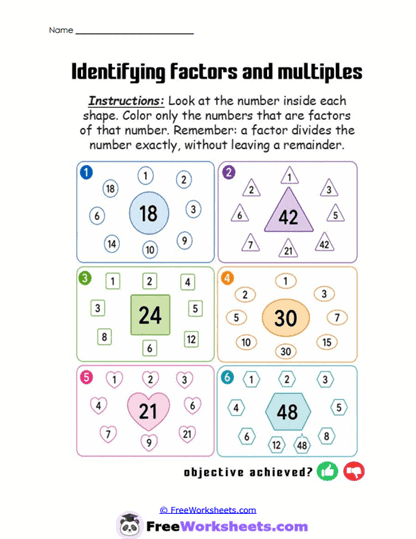
This Grade 4 math worksheet helps children sharpen their factor skills with target numbers such as 18, 42, 24, 30, 21, and 48. Each target is surrounded by a group of number choices, and students must color only the numbers that are true factors.
The activity gives children repeated practice deciding whether a number fits evenly into another number. Because the targets include both smaller and larger values, students get to use a wide range of multiplication facts.
Learning Goals
The main goal is to help students recognize factor relationships quickly and accurately.
Children practice understanding that a factor must divide the target exactly, without leaving anything over. They also strengthen their multiplication knowledge by connecting factors to factor pairs.
For example, if the target is 42, students can use facts such as 6 × 7 = 42 and 3 × 14 = 42 to help identify the correct choices.
What Students Will Do
Students look at one target number at a time.
They study every number surrounding that target and decide whether it belongs in the factor list. Correct factors are colored, while numbers that do not divide evenly are left uncolored.
Students repeat the same process for all six sections.
Some targets, such as 21, have only a few factors. Others, such as 48, have many more. This helps students see that numbers can have very different factor structures.
Common Challenges
A child may confuse a factor with a multiple and choose a number simply because it appears in the same multiplication family.
Another common mistake is forgetting 1 or the target number itself. Both are always factors of a positive whole number.
A teacher or parent can remind the child, “If you divide the target by this number, do you get a whole number?” That gives them a dependable way to check.
Teaching Suggestions
Have students prove uncertain choices with division or multiplication. A quick equation such as 42 ÷ 7 = 6 gives clear evidence that 7 is a factor.
Teachers can also ask students to compare two targets and explain why one has more factors than the other.
Parents can turn the page into a verbal review by pointing to a choice and asking, “Factor or not? Prove it.”
Worksheet Features
The activity includes six target numbers and several possible factors around each one. The mix of values such as 18, 21, 30, 42, and 48 gives students a good range of factor practice.
This worksheet works well for math centers, independent review, homework, or a quick skill check.