
About This Worksheet
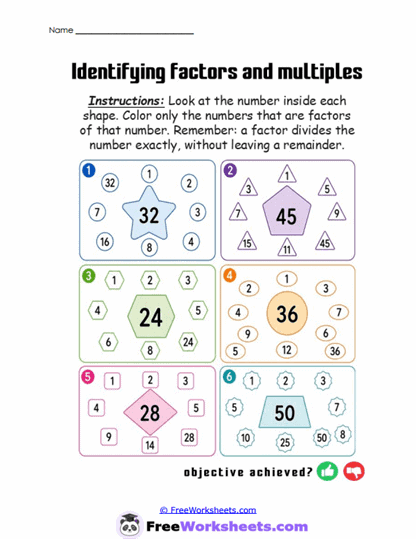
This Grade 4 math worksheet gives children another visual way to practice identifying factors. Students work with target numbers such as 32, 45, 24, 36, 28, and 50. Each target number sits inside a shape, and several possible factors are placed around it. The child’s job is to color only the numbers that divide the target evenly.
This is useful because students have to make a decision about every number they see. They cannot simply memorize a short factor list and move on. They must check whether each choice truly belongs with the target number.
Learning Goals
The main goal is to help students become more accurate and confident when finding factors of larger whole numbers.
Children practice using multiplication facts and division to decide whether a number is a factor. They also begin to notice that some numbers have many factor pairs while others have fewer.
For example, a child working with 36 may recognize pairs such as 1 × 36, 2 × 18, 3 × 12, 4 × 9, and 6 × 6. Those multiplication facts help them identify every correct factor placed around the shape.
What Students Will Do
Students begin with the first target number and look at all of the smaller numbers surrounding it.
For each choice, they ask whether that number divides the target evenly with no remainder. If it does, they color it. If it does not, they leave it alone.
They repeat this process for all six target numbers.
Because numbers such as 32, 36, and 50 have very different factor sets, students need to think through each group separately instead of following one repeated pattern.
Common Challenges
Some children may assume that an even target number means every even number around it must be a factor. That is not true. For example, a number can be even and still not divide the target evenly.
Others may forget less obvious factors because they only think about their easiest multiplication facts.
A parent or teacher can ask, “What number would you multiply this by to get the target?” If the child cannot make a whole-number multiplication equation, that choice is not a factor.
Teaching Suggestions
Encourage students to think in factor pairs instead of testing numbers randomly. For example, once they know 4 × 8 = 32, they know both 4 and 8 are factors.
Teachers can also have children write the complete factor list after they finish coloring one shape. This provides an extra check that no factor was missed.
For stronger students, ask them which target number has the greatest number of factors and how they know.
Worksheet Features
The page includes six target numbers presented in different colorful shapes, with possible factors arranged around each one. The larger values give students practice beyond the easiest multiplication facts while keeping the task visually simple.
This worksheet works well for factor review, independent math work, guided practice, homework, or small-group instruction.