
About This Worksheet
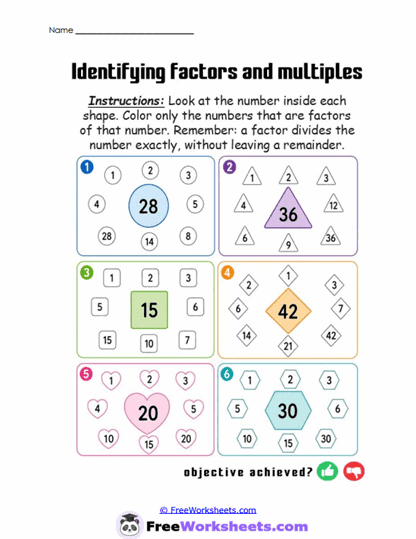
This Grade 4 math worksheet helps children identify factors while working with several different visual shapes. Students examine target numbers such as 28, 36, 15, 42, 20, and 30. Each target appears inside a different shape, with possible factors placed around it.
The math stays the same even though the pictures change. That is useful because it helps children focus on the number relationship instead of depending on one familiar layout.
Learning Goals
The main goal is to strengthen students’ understanding that factors are whole numbers that divide a target number evenly.
Children practice checking whether a number belongs by using division or multiplication facts. They also begin to notice that different numbers have different numbers of factors.
For example, 15 has fewer factor choices than 36, which can lead to useful discussions about how numbers are built.
What Students Will Do
Students begin with the target number inside the first shape.
They look at every smaller number placed around it and test whether that number is a factor. If it divides evenly into the target, they color it. If not, they leave it uncolored.
They continue through all six shapes, repeating the same reasoning each time.
For 42, for example, students may see choices such as 1, 2, 3, 6, 7, 14, 21, and 42. They need to identify all of the numbers that truly divide 42 without a remainder.
Common Challenges
Some children may forget that the target number itself is always a factor. Others may overlook factor pairs because they stop after finding the first few.
A good strategy is to test possible factors in order, beginning with 1 and working upward.
A parent or teacher can also ask, “What multiplication fact proves this?” That encourages the child to connect the factor to a complete equation.
Teaching Suggestions
Teachers can have students say the factor pair aloud each time they color a correct number. For instance, “7 and 6 are a factor pair of 42.”
Parents can make the practice more hands-on by using counters to build equal groups. If 20 counters can be split into 4 equal groups, then 4 is a factor of 20.
For extra challenge, ask students to write the full factor list for one of the target numbers after the coloring is complete.
Worksheet Features
The page includes six differently shaped factor problems with several choices around each target number. The varied layout keeps the task visually fresh while reinforcing the same core skill.
This worksheet works well for factor review, homework, guided math, or independent Grade 4 practice.