
About This Worksheet
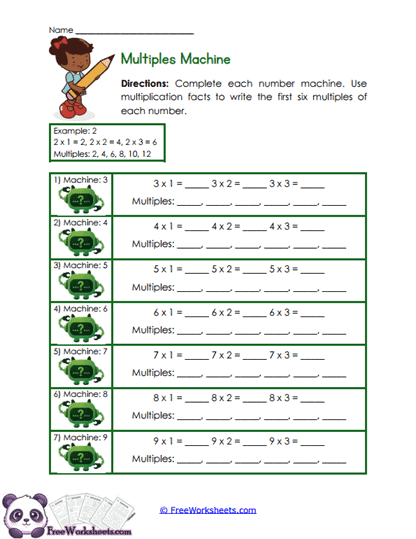
This Grade 4 math worksheet helps children build a strong understanding of multiples by connecting them directly to multiplication facts. Students work with the numbers 3, 4, 5, 6, 7, 8, and 9. For each one, they complete multiplication facts and then write the first six multiples in order.
This is useful because many children can recite a few multiplication facts but do not always understand that those answers are also multiples of the starting number. This page makes that connection very clear. For example, when students solve 4 × 1, 4 × 2, 4 × 3, and so on, they are building the list of multiples of 4 at the same time.
Learning Goals
The main goal is to help students understand that multiples are the numbers you get when you multiply a whole number by 1, 2, 3, and so on.
Children practice multiplication facts, skip-counting, number patterns, and the idea that multiples continue in a predictable sequence.
This skill is important for later work with common multiples, fractions, divisibility, and number relationships.
What Students Will Do
Students work through seven “machines,” each based on a different starting number.
They complete multiplication facts such as 3 × 1, 3 × 2, 3 × 3 and continue the pattern until they have the first six products.
Then they write those products in order on the multiples line.
They repeat the same process for 4, 5, 6, 7, 8, and 9.
The goal is for students to see that the multiplication facts and the multiples list are really showing the same pattern in two different ways.
Common Challenges
Some children may confuse factors and multiples. A helpful reminder is that factors go into a number evenly, while multiples are what you get when you keep multiplying the number.
Others may lose track of the pattern if a multiplication fact is not automatic yet. In that case, encourage skip-counting from the previous answer.
Teaching Suggestions
Teachers can model one machine first and say each multiple aloud as it is created. This helps students hear the number pattern as well as see it.
Parents can ask, “What do we add each time?” If the child is working with multiples of 6, the answer should always increase by 6.
For extra practice, have students continue one of the patterns past the sixth multiple.
Worksheet Features
The page includes seven number machines and gives students repeated practice with multiples from 3 through 9. The structure keeps multiplication facts and multiples side by side so the connection is easy to see.
This worksheet works well for multiplication review, factor-and-multiple lessons, homework, or math centers.