
About This Worksheet
This worksheet focuses on understanding timelines and how they help readers organize events in chronological order. Timelines are visual tools that show when events happen and the order in which they occur. Third-grade students strengthen comprehension when they learn to sequence events and recognize patterns in a story. For example, a timeline can help readers clearly see what happened first, next, and last during a field trip. This activity helps students connect visual organization with story understanding.
Curriculum and Grade Alignment
This worksheet is designed for Grade 3 students studying informational and literary text structures. The primary learning goal is sequencing events and understanding the purpose of timelines. Students should already be able to identify beginning, middle, and end events in a story. The next progression involves analyzing cause-and-effect relationships across multiple events. This activity aligns with CCSS RI.3.7 and RL.3.3 and supports TEKS 3.9E through the use of visual organization tools.
Student Tasks
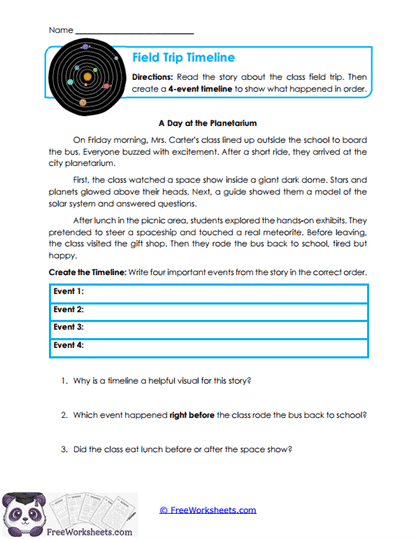
On this worksheet, students will read a story about a class field trip to a planetarium. Learners will identify important events and place them in chronological order on a timeline. Students answer follow-up questions that require careful sequencing and attention to details. They also explain why a timeline is helpful for understanding the story. The activity combines comprehension and visual literacy skills.
Common Challenges and Misconceptions
Many students remember events but struggle to place them in the correct order. Some learners confuse events that happened close together in the story. Others may focus on small details rather than major events. Readers sometimes think a timeline is only useful for historical topics. Teachers should encourage students to think about how timelines help organize any sequence of events.
Implementation Guidance
Teachers can use this worksheet during lessons on sequencing and visual organization. It works well as a bridge between reading comprehension and informational text features. Parents may discuss timelines of family events or vacations. Homeschool educators can extend learning by having students create timelines from books they read independently. The worksheet helps students become more organized readers.
Details and Features
The worksheet includes a narrative passage and a timeline organizer. Students practice sequencing, identifying key events, and explaining visual tools. Reflection questions encourage critical thinking about organization. The printable design supports classroom instruction, homework assignments, intervention groups, and homeschool learning. Its engaging field trip theme keeps students interested while practicing important skills.