
About This Worksheet
This worksheet focuses on identifying personification in a literary passage. Personification is a literary device that gives human actions, feelings, or characteristics to animals, objects, or natural forces. Third-grade students learn how authors use personification to make settings and events feel more alive and engaging. For example, “The trees waved their branches” gives trees a human action to create a stronger image. This activity helps readers recognize how figurative language adds interest and emotion to stories.
Curriculum and Grade Alignment
This worksheet is designed for Grade 3 students learning about literary devices and descriptive writing. The primary objective is identifying personification and explaining its effect on a text. Students should already be familiar with basic story elements and descriptive language. The next step is analyzing how literary devices contribute to mood, setting, and characterization. This activity aligns with CCSS RL.3.4 and supports TEKS 3.10D through interpretation of figurative language.
Student Tasks
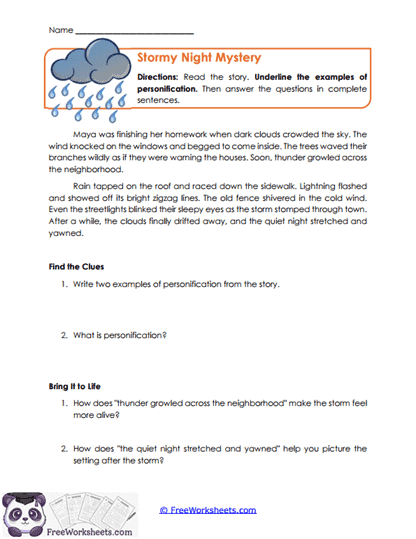
On this worksheet, students will read a short story about a storm moving through a neighborhood. They will locate examples of personification and record them as evidence from the text. Learners must explain how the personification makes the storm feel more vivid and alive. Students also answer questions about how figurative language affects the setting after the storm passes. The activity encourages close reading and thoughtful literary analysis.
Common Challenges and Misconceptions
Many students identify action words but do not recognize when those actions are being assigned to nonhuman things. Some learners confuse personification with ordinary description. Others can find an example but struggle to explain its purpose in the story. Readers sometimes focus only on what happened instead of how the author described it. Teachers should encourage students to ask whether a human action is being given to something that is not a person.
Implementation Guidance
Teachers can use this worksheet during lessons on figurative language or narrative reading. It works well as guided practice before students begin writing their own examples of personification. Parents may discuss how the storm seems to behave like a living character in the story. Homeschool educators can extend learning by having students rewrite ordinary sentences using personification. The worksheet builds both reading comprehension and literary analysis skills.
Details and Features
The worksheet includes a short narrative passage filled with age-appropriate examples of personification. Students complete written responses that require identification and explanation of literary devices. The questions move beyond recognition and encourage deeper thinking about author choices. The printable design is suitable for classroom lessons, homework assignments, and homeschool instruction. Its focused format helps students connect figurative language with story meaning.