
About This Worksheet
This worksheet focuses on identifying the main idea of individual sections within an informational article. A main idea is the most important message a section or passage is teaching the reader. Third-grade students benefit from learning that longer nonfiction texts are often divided into smaller parts, each with its own important idea. For example, a section about desert animals may have the main idea that animals use special adaptations to survive in harsh conditions. This skill helps readers organize information and understand nonfiction texts more effectively.
Curriculum and Grade Alignment
This activity is designed for Grade 3 students studying informational text structure and comprehension. The primary learning goal is determining the main idea of separate sections within a nonfiction article. Students should already know how to identify important details in a passage. The next step in learning is summarizing multiple sections and explaining how ideas connect across an entire text. This worksheet aligns with CCSS RI.3.2 and supports TEKS 3.6G by helping students identify central ideas in informational reading.
Student Tasks
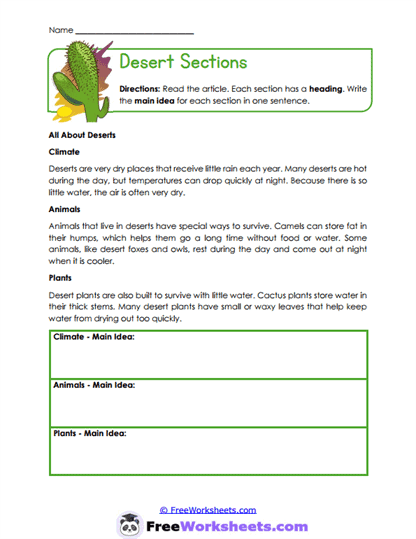
On this worksheet, students will read an article about deserts that is divided into sections with headings. They will examine information about climate, animals, and plants found in desert environments. Learners must determine the most important idea presented in each section and write a complete sentence summarizing it. The activity requires students to separate key information from supporting details. Careful reading and thoughtful summarizing are essential throughout the lesson.
Common Challenges and Misconceptions
Many students try to include every detail instead of focusing on the most important idea. Some learners write a topic word or phrase rather than a complete main idea sentence. Others may confuse details from one section with information from another section. Readers sometimes overlook the headings, even though they provide clues about the section’s focus. Teachers should model how to combine related details into one clear summary statement.
Implementation Guidance
Teachers can use this worksheet during lessons on nonfiction text features and organization. It works well as guided practice before students begin summarizing longer informational texts. Parents may discuss each section aloud and ask what the author most wants readers to learn. Homeschool educators can extend the lesson by having students compare the main ideas from different sections. The activity supports strong comprehension and organizational reading skills.
Details and Features
The worksheet includes a nonfiction article divided into clearly labeled sections with headings. Students practice identifying the main idea for multiple parts of the text rather than just one overall idea. Dedicated response spaces help learners organize their thinking and written answers. The printable format is suitable for classroom lessons, intervention groups, homework, and homeschool instruction. The focused design encourages close reading and effective summarization.