
About This Worksheet
This worksheet focuses on categorizing information from an informational text into organized groups. Categorizing is the process of sorting facts according to shared characteristics or topics. Third-grade students improve comprehension when they learn how to organize details into meaningful categories. For example, information about where sea turtles live belongs under habitat, while information about what they eat belongs under diet. This activity helps readers understand and remember nonfiction information more effectively.
Curriculum and Grade Alignment
This worksheet is designed for Grade 3 students studying informational reading and organizational skills. The primary objective is identifying important details and placing them into appropriate categories. Students should already know how to locate facts in a nonfiction passage. The next skill progression involves comparing information across categories and summarizing informational texts. This activity aligns with CCSS RI.3.2 and RI.3.7 while supporting TEKS 3.6F through evidence-based information gathering.
Student Tasks
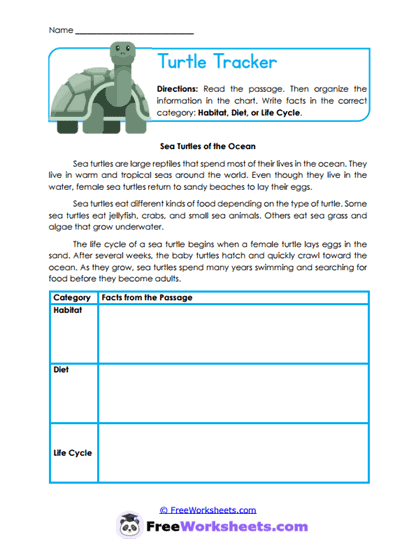
On this worksheet, students will read an informational article about sea turtles and their lives in the ocean. They will identify facts related to habitat, diet, and life cycle. Learners must sort information from the passage into the correct category within a chart. The activity requires students to analyze details and determine where each piece of information belongs. Careful reading and organization are important throughout the task.
Common Challenges and Misconceptions
Many students understand the facts but place them into the wrong category. Some learners copy entire sentences instead of selecting the most important information. Others may overlook details because they focus only on one section of the article. Readers sometimes confuse life cycle information with habitat descriptions. Teachers should encourage students to reread category labels and verify that each fact matches the heading.
Implementation Guidance
Teachers can use this worksheet during nonfiction reading lessons, science integration activities, or comprehension practice sessions. It works well for teaching students how to organize information visually. Parents may help children discuss each category before filling in the chart. Homeschool educators can extend learning by asking students to create additional categories or research related animal facts. The activity promotes both reading comprehension and information management skills.
Details and Features
The worksheet includes a nonfiction passage about sea turtles paired with an easy-to-follow graphic organizer. Students sort details into clearly labeled categories, providing meaningful organizational practice. The chart format supports visual learners and helps make information easier to understand. The printable design is suitable for classroom centers, homework, intervention, and homeschool use. Its structured layout encourages thoughtful reading and accurate categorization.