
About This Worksheet
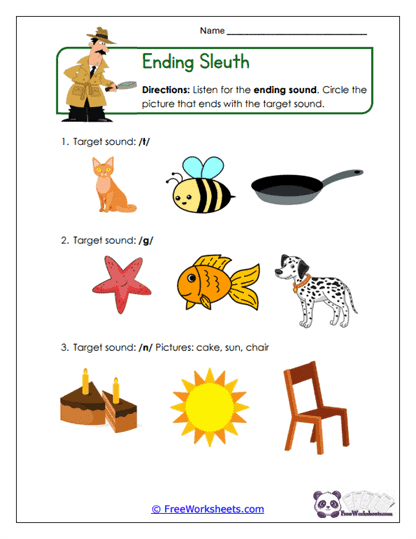
Ending Sleuth is a phonemic awareness activity that focuses on identifying final consonant sounds in spoken words. It is designed for Kindergarten students who are building foundational listening and sound discrimination skills. Final sound identification is the ability to hear and isolate the last phoneme in a word. For example, dog ends with the /g/ sound, so students select the picture that matches that ending sound. This worksheet strengthens auditory processing needed for early spelling and decoding.
Curriculum and Grade Alignment
This worksheet supports Kindergarten standards related to isolating and pronouncing final sounds in CVC words. The primary learning objective is accurate identification of ending phonemes in familiar vocabulary. Students should already recognize common consonant sounds before completing this activity. Mastery prepares learners for spelling simple words by representing beginning and ending sounds. It aligns with Common Core RF.K.2.D and supports TEKS ELAR K.2.A in phonological awareness.
Student Tasks
On this worksheet, students will listen to a target sound and review three picture choices. They identify which picture name ends with the specified sound. Learners circle the correct image to demonstrate understanding. Each set reinforces listening for the final phoneme rather than the beginning. The repeated format provides structured practice across multiple examples.
Common Challenges and Misconceptions
Young learners often focus on the first sound they hear instead of the final sound. Some students may incorrectly rely on visual spelling rather than auditory analysis. Similar ending sounds such as /n/ and /m/ can also cause confusion. Mispronunciation of picture names may lead to incorrect answers. Teachers should model stretching the word slowly and emphasizing the last sound clearly.
Implementation Guidance
Teachers can use this worksheet during a small-group phonics lesson focused on ending sounds. It works well as a listening center activity where words are spoken aloud. Parents and homeschool educators may say each picture name slowly to guide children in isolating the final sound. This resource can also serve as a quick formative assessment. Repeated practice strengthens early decoding and spelling readiness.
Details and Features
The worksheet includes clearly illustrated pictures paired with a designated target sound. Each question presents three image options to support visual discrimination. The layout is simple and uncluttered for Kindergarten learners. It is formatted for easy black-and-white printing. The structure allows for quick review and correction.