
About This Worksheet
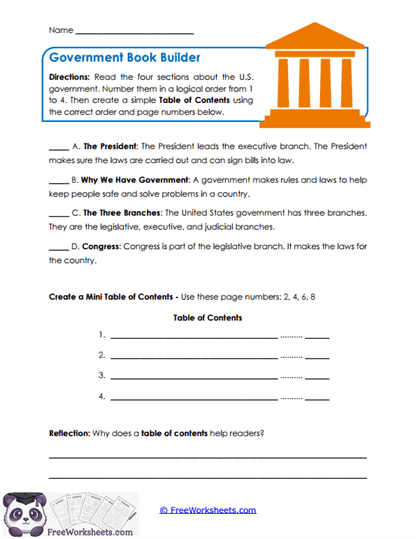
This worksheet focuses on understanding how a table of contents organizes information in a nonfiction book. A table of contents gives readers a roadmap by listing sections and page numbers in order. Third-grade students strengthen informational reading skills when they learn how authors organize topics and help readers find information quickly. For example, instead of searching through an entire book, readers can use a table of contents to turn directly to the section they need. This activity helps students understand both text organization and text features.
Curriculum and Grade Alignment
This worksheet is designed for Grade 3 students studying informational text features and nonfiction organization. The primary learning goal is creating and using a table of contents. Students should already understand headings and page numbers within nonfiction texts. The next progression involves independently using multiple text features while researching and reading informational texts. This activity aligns with CCSS RI.3.5 and supports TEKS 3.9F through the study of organizational text features.
Student Tasks
On this worksheet, students will read several short informational sections about the United States government. They will place the sections into a logical order and then create a mini table of contents using provided page numbers. Learners must think about how information should be organized for readers. Students also explain why a table of contents is useful. The activity develops organization, sequencing, and nonfiction reading skills.
Common Challenges and Misconceptions
Many students understand what a table of contents looks like but struggle to create one. Some learners focus on page numbers without considering the logical order of topics. Others may confuse headings with chapter titles. Readers sometimes forget that a table of contents is designed to help readers locate information efficiently. Teachers should encourage students to think about how books are organized from general topics to more specific details.
Implementation Guidance
Teachers can use this worksheet during lessons on informational text organization. It works well after students have explored real nonfiction books and examined their tables of contents. Parents may look through nonfiction books at home and discuss how the contents page helps readers. Homeschool educators can extend learning by having students create a table of contents for their own informational writing projects. The worksheet provides meaningful practice with nonfiction structures.
Details and Features
The worksheet combines reading comprehension, sequencing, and text feature analysis. Students practice organizing information and building a table of contents from scratch. Reflection questions encourage deeper thinking about nonfiction reading tools. The printable format supports classroom instruction, homework assignments, literacy centers, and homeschool learning. Its practical focus helps students understand how informational books are structured.