
About This Worksheet
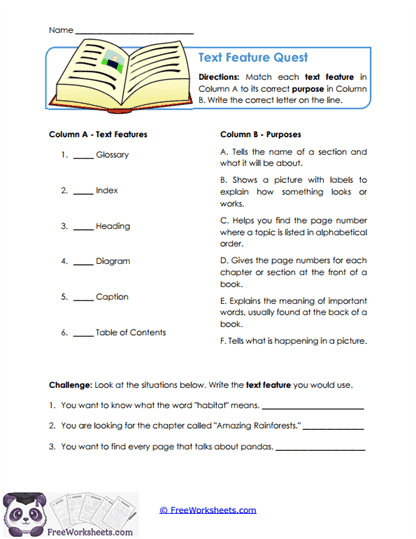
This worksheet focuses on identifying common text features and understanding their purposes in nonfiction reading. Text features are special tools authors include to help readers find information, understand ideas, and learn new vocabulary more easily. Third-grade students become stronger readers when they know how to use features such as glossaries, indexes, headings, diagrams, captions, and tables of contents. For example, a glossary can help a reader understand an unfamiliar word, while an index can help locate information quickly. This activity helps students build confidence when navigating informational texts.
Curriculum and Grade Alignment
This worksheet is designed for Grade 3 students studying informational text structures and text features. The primary learning goal is identifying text features and matching them to their purposes. Students should already have some experience reading nonfiction books and articles. The next progression involves using text features independently to gather information and answer questions. This activity aligns with CCSS RI.3.5 and supports TEKS 3.9F by helping students understand and use informational text features.
Student Tasks
On this worksheet, students will match several common text features with their correct definitions and purposes. They will then apply what they learned by choosing the best text feature for different reading situations. Learners must think about which feature would help them locate information, understand vocabulary, or learn about a topic. The activity encourages practical application of nonfiction reading skills. Students strengthen both recognition and real-world use of text features.
Common Challenges and Misconceptions
Many students confuse the glossary and index because both help readers find information. Some learners mix up captions and diagrams because both are often connected to pictures. Others may know what a feature looks like but not understand its purpose. Readers sometimes choose features based on appearance rather than function. Teachers should encourage students to think about what problem each text feature helps solve for a reader.
Implementation Guidance
Teachers can use this worksheet during introductory lessons on nonfiction text features. It works well as a review activity before students begin larger informational text projects. Parents may discuss examples of text features found in magazines, books, or websites. Homeschool educators can extend learning by having students locate each feature in a nonfiction book at home. The worksheet builds foundational nonfiction reading skills.
Details and Features
The worksheet includes matching activities and real-world application questions. Students practice identifying six major text features commonly found in informational texts. The format encourages critical thinking about when and why readers use specific features. The printable design supports classroom instruction, literacy centers, homework assignments, and homeschool learning. Its structured approach makes nonfiction navigation easier for developing readers.