
About This Worksheet
This worksheet focuses on identifying an author’s purpose in poetry. Author’s purpose is the reason a writer creates a text, such as to entertain, inform, persuade, or describe. Third-grade students strengthen reading comprehension when they learn to recognize clues that reveal a poet’s goal. For example, a poem encouraging readers to recycle is often written to persuade people to take action. This activity helps students think critically about why a poem was written.
Curriculum and Grade Alignment
This worksheet is designed for Grade 3 students studying poetry comprehension and author’s purpose. The primary learning goal is identifying the poet’s purpose and supporting that conclusion with textual evidence. Students should already be able to understand the main idea of a poem. The next progression involves analyzing how word choice and structure support an author’s goals. This activity aligns with CCSS RL.3.6 and supports TEKS 3.9E by helping students analyze purpose and message.
Student Tasks
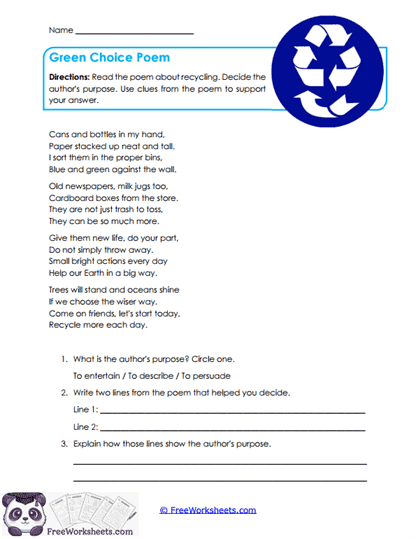
On this worksheet, students will read a poem about recycling and caring for the environment. They will determine whether the author’s purpose is to entertain, describe, or persuade. Learners must identify lines from the poem that support their choice. Students also explain how those lines reveal the poet’s intention. The activity encourages evidence-based thinking and careful analysis.
Common Challenges and Misconceptions
Many students confuse the topic of a poem with the author’s purpose. Some learners choose a purpose based on personal preference rather than textual evidence. Others identify supporting lines but struggle to explain how they support the author’s goal. Readers sometimes overlook persuasive language because they focus only on the poem’s subject. Teachers should encourage students to ask what the poet wants readers to think, feel, or do.
Implementation Guidance
Teachers can use this worksheet during lessons on author’s purpose and poetry analysis. It works well as guided practice before students analyze more complex texts. Parents may discuss how advertisements, books, and poems all have different purposes. Homeschool educators can extend learning by comparing poems written for different purposes. The worksheet helps students become more thoughtful and analytical readers.
Details and Features
The worksheet includes a meaningful poem about environmental responsibility and recycling. Students practice identifying purpose, locating evidence, and explaining their reasoning. The structured response format supports both comprehension and written communication skills. The printable design is suitable for classroom instruction, homework assignments, intervention groups, and homeschool learning. Its real-world topic encourages engagement and thoughtful discussion.