
About This Worksheet
This worksheet focuses on identifying sensory details within a poem. Sensory details are words and phrases that appeal to the senses of sight, sound, smell, taste, and touch. Third-grade students strengthen reading comprehension when they recognize how poets help readers imagine experiences through descriptive language. For example, “sweet berries” appeals to taste, while “cool breeze” appeals to touch. This activity helps students understand imagery and how it creates vivid mental pictures.
Curriculum and Grade Alignment
This worksheet is designed for Grade 3 students studying imagery and descriptive language in poetry. The primary learning goal is identifying sensory details and categorizing them by sense. Students should already be familiar with the five senses and basic descriptive language. The next progression involves analyzing how sensory details contribute to mood and theme. This activity aligns with CCSS RL.3.4 and supports TEKS 3.10D through interpretation of poetic language.
Student Tasks
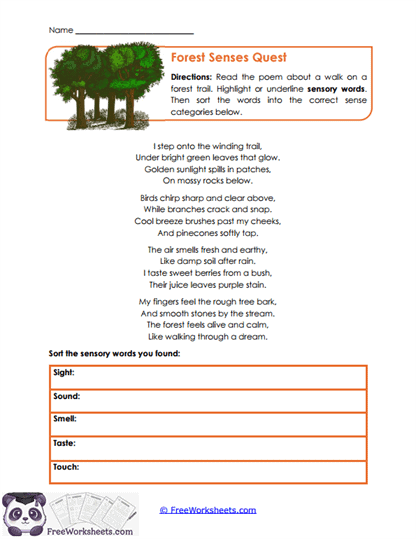
On this worksheet, students will read a poem about walking through a forest trail. They will locate sensory words and phrases throughout the poem. Learners must sort the details into categories for sight, sound, smell, taste, and touch. Students use context clues to determine which sense each detail represents. The activity encourages careful reading and thoughtful analysis of imagery.
Common Challenges and Misconceptions
Many students can find descriptive words but struggle to place them in the correct sensory category. Some learners focus only on visual imagery and overlook details related to smell, taste, or touch. Others may place a phrase into multiple categories without considering its strongest sensory connection. Readers sometimes skim the poem and miss important descriptive language. Teachers should encourage students to imagine experiencing each detail while reading.
Implementation Guidance
Teachers can use this worksheet during lessons on imagery and descriptive language. It works well as a cross-curricular activity connecting reading and science concepts related to the senses. Parents may discuss each sensory category and help children identify examples from the poem. Homeschool educators can extend learning by having students write their own sensory descriptions of outdoor experiences. The worksheet builds strong visualization and comprehension skills.
Details and Features
The worksheet includes a nature-themed poem filled with sensory imagery. Students organize information into a structured chart based on the five senses. The format supports both reading comprehension and vocabulary development. The printable design is suitable for classroom instruction, homework, intervention groups, and homeschool learning. Its visual organization makes sensory analysis easy for developing readers.