
About This Worksheet
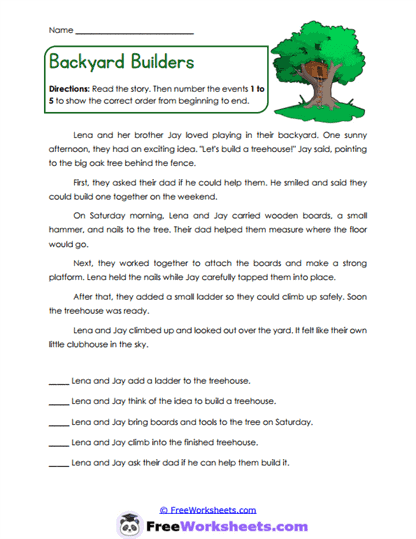
This worksheet focuses on sequencing events in a literary story. Sequencing is the ability to identify the order in which events happen from beginning to end. Third-grade students strengthen comprehension when they can track how one event leads to another throughout a narrative. For example, having an idea to build a treehouse happens before gathering tools and materials. This activity helps readers understand plot development and story structure.
Curriculum and Grade Alignment
This worksheet is designed for Grade 3 students studying narrative comprehension and story structure. The primary learning goal is identifying and organizing events in chronological order. Students should already be able to recognize beginning, middle, and end story elements. The next progression involves summarizing stories and explaining cause-and-effect relationships between events. This activity aligns with CCSS RL.3.3 and supports TEKS 3.8A by helping students analyze plot development.
Student Tasks
On this worksheet, students will read a story about two children building a treehouse. They will identify important events that occur throughout the narrative. Learners must place the events in the correct sequence from the beginning of the story to the end. Students use details from the passage to determine which actions happen first, next, and last. The activity encourages careful reading and logical thinking.
Common Challenges and Misconceptions
Many students remember individual events but struggle to place them in the correct order. Some learners focus on the most exciting event instead of considering the entire sequence. Others may confuse events that happen close together in the story. Readers sometimes rely on memory rather than returning to the text for evidence. Teachers should encourage students to look for transition words and reread key sections before deciding on the sequence.
Implementation Guidance
Teachers can use this worksheet during lessons on plot structure and sequencing. It works well as independent practice after modeling how to identify chronological events. Parents may have children retell the story aloud before completing the ordering activity. Homeschool educators can extend learning by asking students to explain why each event belongs in its position. The worksheet builds strong comprehension and organizational skills.
Details and Features
The worksheet includes a relatable story about building a backyard treehouse. Students complete a sequencing task that reinforces understanding of narrative order. The format provides focused practice without overwhelming developing readers. The printable design is suitable for classroom lessons, literacy centers, homework, and homeschool learning. Its structured approach helps students visualize the flow of events in a story.