
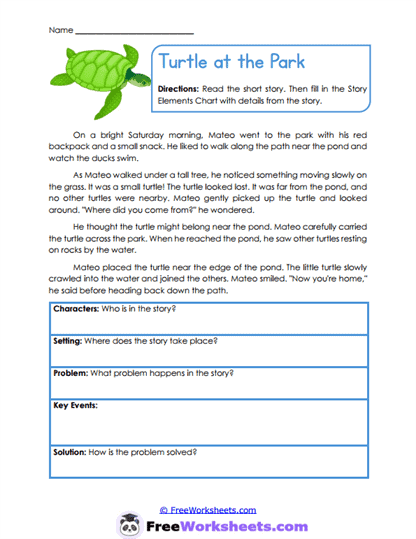
About This Worksheet
This worksheet focuses on identifying the key story elements in a literary text. Story elements are the important parts of a story, including characters, setting, problem, events, and solution. Third-grade students strengthen comprehension when they learn how these elements work together to create a complete narrative. For example, a lost turtle becomes the problem, while returning it to the pond becomes the solution. This activity helps students organize story information and better understand narrative structure.
Curriculum and Grade Alignment
This worksheet is designed for Grade 3 students studying literary text comprehension. The primary learning goal is identifying and analyzing story elements within a narrative. Students should already be able to read and understand short fictional stories. The next progression involves explaining how characters’ actions affect events and outcomes. This activity aligns with CCSS RL.3.3 and supports TEKS 3.8A by helping students describe plot elements and character actions.
Student Tasks
On this worksheet, students will read a short story about a boy who finds a turtle at a park. They will identify the main character and determine where the story takes place. Learners must explain the problem that occurs and summarize the important events that lead to a solution. Students complete a story elements chart using details directly from the text. The activity encourages close reading and organized thinking.
Common Challenges and Misconceptions
Many students confuse events with the problem or solution in the story. Some learners provide details that are true but not the most important information for a story element category. Others may focus on minor events instead of identifying key plot points. Readers sometimes struggle to summarize events without copying entire sentences. Teachers should model how to identify the most important details connected to each story element.
Implementation Guidance
Teachers can use this worksheet during lessons on narrative structure and reading comprehension. It works well as guided practice before students analyze longer stories. Parents may discuss each story element aloud before students complete the chart. Homeschool educators can extend learning by having students create their own story maps for books they read independently. The worksheet builds a strong foundation for understanding plot and character development.
Details and Features
The worksheet includes a short, engaging narrative that is appropriate for Grade 3 readers. A structured graphic organizer helps students categorize story elements clearly. The layout provides dedicated spaces for characters, setting, problem, events, and solution. The printable format works well for classroom instruction, homework, intervention groups, and homeschool learning. Its organized design supports comprehension and story analysis skills.