
About This Worksheet
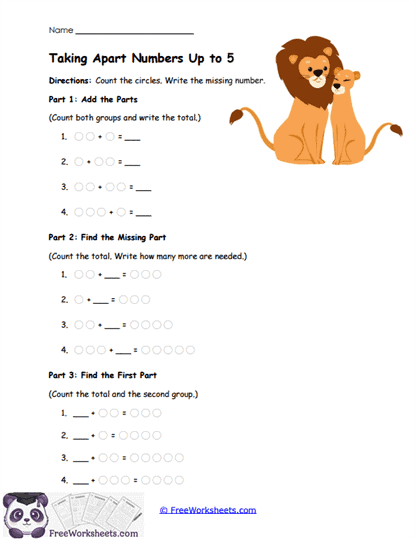
This worksheet is a Kindergarten math activity that helps students practice breaking apart numbers up to 5 into smaller groups. Children count circles and determine missing number parts in simple part-part-whole problems. The activity strengthens number sense, counting fluency, and early addition and subtraction understanding. For example, if there are 5 circles total and 2 are already shown, students figure out that 3 more are needed. The visual circle groups make it easier for young learners to understand how numbers can be separated into parts.
Curriculum and Grade Alignment
This worksheet is designed for Kindergarten students learning how to compose and decompose numbers within 5. The primary learning goal is helping children understand that numbers can be broken into smaller groups in different ways. Students should already know how to count objects accurately before beginning the worksheet. These foundational number skills prepare learners for future work with addition, subtraction, and fact families in first grade. This worksheet supports Common Core Standard K.OA.A.3 and aligns with TEKS K.3.A for composing and decomposing numbers using objects and drawings.
Student Tasks
On this worksheet, students will count groups of circles and fill in missing numbers to complete part-part-whole problems. Children determine totals, missing parts, and starting groups using visual models. Learners practice counting carefully while strengthening number relationships and problem-solving skills. Students also build confidence understanding how smaller groups combine to make whole numbers. The repeated circle models help children visualize number combinations clearly.
Common Challenges and Misconceptions
Some students may struggle to understand which number represents the whole group and which numbers are the parts. Young learners sometimes forget to count all the circles before solving the missing number problem. A few children may guess answers instead of using the circle models carefully. Students who are still developing counting fluency may also skip circles while counting. Teachers and parents can help by encouraging children to point to each circle while counting aloud slowly.
Implementation Guidance
Teachers can use this worksheet during number sense lessons, guided math instruction, or independent practice focused on composing and decomposing numbers. Parents may find the visual circle groups helpful because they make number relationships easier for children to understand during home learning sessions. Students can use counters or draw extra circles to model the problems before writing answers. This worksheet also works well as preparation for beginner addition and subtraction equations. Adults should encourage learners to explain how they found the missing number part.
Details and Features
This printable worksheet includes several part-part-whole problems using circle groups and numbers up to 5. Large answer spaces and organized sections support Kindergarten students who are still developing writing and counting confidence. The black-and-white design prints clearly for classroom packets, homework assignments, or homeschool instruction. Simple visual models help children focus on understanding number combinations and missing parts. Its beginner-friendly layout makes the worksheet useful for review practice, intervention, or early math assessments.