
About This Worksheet
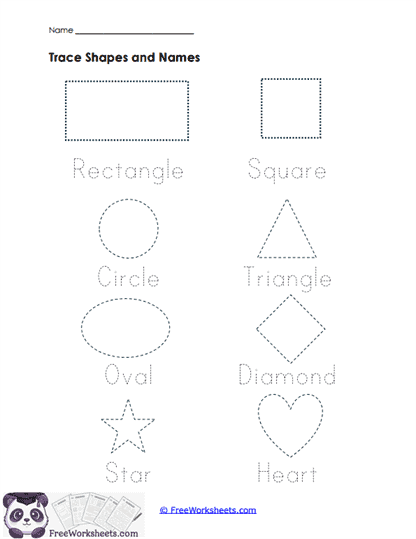
This worksheet is a Kindergarten geometry activity that helps students trace common 2D shapes and their names. Children practice tracing rectangles, squares, circles, triangles, ovals, diamonds, stars, and hearts using dotted outlines. The activity strengthens shape recognition, handwriting, and fine motor skills while helping young learners connect shape pictures to shape words. For example, a triangle has 3 sides and students trace both the triangle shape and the word triangle. The repeated tracing practice helps children become more comfortable identifying and naming shapes.
Curriculum and Grade Alignment
This worksheet is designed for Kindergarten students learning how to identify and describe basic 2D shapes. The primary learning goal is helping children recognize shape names and connect them to visual models through tracing activities. Students should already be familiar with basic shape vocabulary before beginning the worksheet. These foundational geometry skills prepare learners for future work with shape attributes, sorting, and drawing shapes independently in later grades. This worksheet supports Common Core Standard K.G.A.2 and aligns with TEKS K.6.A for identifying and describing two-dimensional shapes.
Student Tasks
On this worksheet, students will trace shape outlines and trace the matching shape names underneath each picture. Children follow dotted lines carefully while practicing shapes such as circles, squares, triangles, and stars. Learners strengthen fine motor control while building geometry vocabulary and shape recognition skills. Students also improve letter formation and handwriting through repeated tracing practice. The organized layout helps children focus on one shape and word pair at a time.
Common Challenges and Misconceptions
Some students may confuse shapes with similar features, such as rectangles and squares. Young learners sometimes rush through tracing and move outside the dotted lines. A few children may recognize the shape but struggle to connect it to the written shape name. Students who are still developing fine motor skills may also need extra support holding a pencil correctly while tracing. Teachers and parents can help by modeling how to trace slowly and say each shape name aloud during practice.
Implementation Guidance
Teachers can use this worksheet during geometry lessons, handwriting practice, or independent center activities. Parents may find the tracing format helpful because it combines shape learning with early writing practice at home. Students can trace shapes with crayons, markers, or colored pencils to make the activity more engaging. This worksheet also works well as an introduction to geometry vocabulary before students begin drawing shapes independently. Adults should encourage learners to name each shape aloud after tracing it.
Details and Features
This printable worksheet includes several dotted-outline 2D shapes and matching shape words for tracing practice. Large tracing lines support Kindergarten students who are still developing handwriting and fine motor skills. The black-and-white design prints clearly for classroom lessons, homework assignments, or homeschool instruction. Simple formatting helps young learners stay focused on geometry and handwriting skills without distractions. Its beginner-friendly structure makes the worksheet useful for review practice, intervention, or early shape assessments.