
About This Worksheet
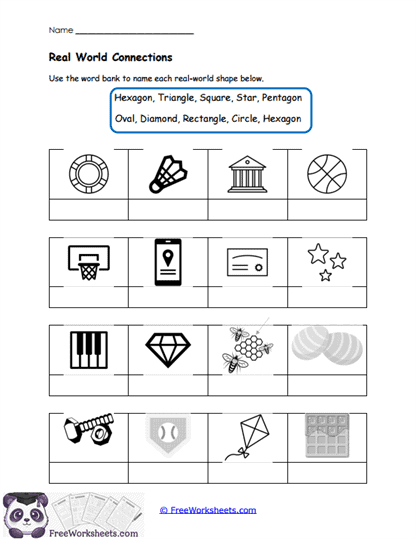
This worksheet is a Kindergarten geometry activity that helps students connect 2D shapes to real-world objects. Children use a word bank to identify shapes shown in everyday items such as basketballs, windows, stars, and signs. The activity strengthens shape recognition, geometry vocabulary, and observation skills while helping young learners see how shapes appear in the world around them. For example, a basketball can represent a circle and a kite can represent a diamond shape. The real-world picture examples make geometry concepts easier and more meaningful for children.
Curriculum and Grade Alignment
This worksheet is intended for Kindergarten students learning how to identify and describe common 2D shapes. The main learning goal is helping children recognize shapes in familiar objects and connect geometry vocabulary to everyday life. Students should already know the names of basic 2D shapes before beginning the worksheet. These foundational geometry skills support future work with shape attributes, classification, and spatial reasoning in later grades. This worksheet supports Common Core Standard K.G.A.2 and aligns with TEKS K.6.A for identifying and describing two-dimensional shapes.
Student Tasks
On this worksheet, students will look at real-world objects and write the matching shape names from the word bank. Children identify shapes such as circles, triangles, rectangles, diamonds, stars, hexagons, and ovals hidden in everyday pictures. Learners practice visual discrimination while strengthening geometry vocabulary and observation skills. Students also build confidence recognizing how shapes appear in common objects around them. The repeated matching practice helps children connect geometry concepts to real-life experiences.
Common Challenges and Misconceptions
Some students may focus more on the object itself than the shape represented by the object. Young learners sometimes confuse shapes that share similar features, such as squares and rectangles or circles and ovals. A few children may struggle with less familiar shapes such as hexagons or pentagons. Students who are still building geometry vocabulary may also need extra support using the word bank correctly. Teachers and parents can help by discussing each shape and pointing out examples from the classroom or home before students begin.
Implementation Guidance
Teachers can use this worksheet during geometry lessons, real-world math activities, or independent practice sessions. Parents may find the real-world examples helpful because they make geometry feel more practical and easier to understand during home learning sessions. Students can point to the objects and describe their shapes aloud before writing answers. This worksheet also works well as a discussion activity where children search for similar shapes around the classroom or house. Adults should encourage learners to explain why each object matches a certain shape.
Details and Features
This printable worksheet includes a word bank and several real-world object pictures representing common 2D shapes. Large illustrations and organized answer spaces support Kindergarten students who are still developing writing and observation skills. The black-and-white format prints clearly for classroom packets, homeschool instruction, or homework assignments. Familiar objects help keep young learners engaged while practicing geometry vocabulary. Its structured layout makes the worksheet useful for review practice, intervention, or early geometry assessments.