
About This Worksheet
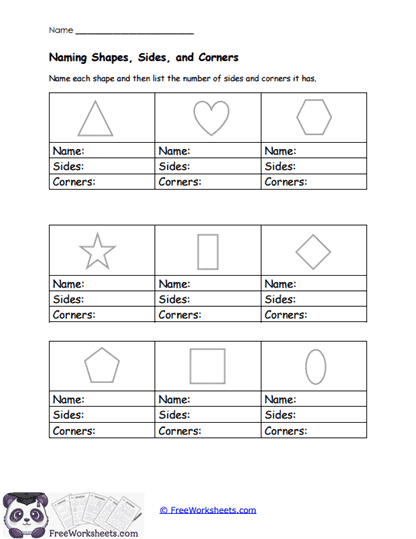
This worksheet is a Kindergarten geometry activity that helps students identify 2D shapes and describe their attributes. Children name each shape and record how many sides and corners the shape has. The activity strengthens geometry vocabulary, shape recognition, and observation skills while introducing students to shape attributes in a simple way. For example, a triangle has 3 sides and 3 corners, while a circle has no corners. The organized chart format helps young learners practice describing shapes step by step.
Curriculum and Grade Alignment
This worksheet is designed for Kindergarten students learning how to identify and describe basic 2D shapes. The primary learning goal is helping children recognize shape names and understand that shapes have different numbers of sides and corners. Students should already know common shape names before beginning the activity. These foundational geometry skills prepare learners for future work with polygons, shape classification, and geometry vocabulary in later grades. This worksheet supports Common Core Standard K.G.B.4 and aligns with TEKS K.6.A for identifying and describing two-dimensional shapes and their attributes.
Student Tasks
On this worksheet, students will look at each shape, write the correct shape name, and count the number of sides and corners it has. Children examine shapes such as triangles, hearts, stars, hexagons, rectangles, diamonds, pentagons, squares, and ovals. Learners practice geometry vocabulary while strengthening counting and observation skills. Students also build confidence describing shape features using simple math language. The repeated chart format helps children focus on one shape at a time.
Common Challenges and Misconceptions
Some students may confuse sides and corners when counting shape attributes. Young learners sometimes count curved edges on circles or ovals as sides even though they are not straight. A few children may struggle with more complex shapes such as stars, pentagons, or hexagons. Students who are still building geometry vocabulary may also mix up shape names while writing them down. Teachers and parents can help by tracing the sides and corners together before students record their answers.
Implementation Guidance
Teachers can use this worksheet during geometry lessons, guided math groups, or independent review activities focused on shape attributes. Parents may find the chart format helpful because it encourages children to slow down and examine each shape carefully during home learning sessions. Students can use crayons or fingers to trace around each shape while counting sides and corners aloud. This worksheet also works well as preparation for later lessons about polygons and shape classification. Adults should encourage learners to explain how they counted the sides and corners for each shape.
Details and Features
This printable worksheet includes several common 2D shapes with organized spaces for naming shapes and recording sides and corners. Large shape outlines support Kindergarten students who are still developing visual observation and handwriting skills. The black-and-white format prints clearly for classroom lessons, homework assignments, or homeschool instruction. Simple charts and repeated directions help young learners stay focused while practicing geometry concepts. Its beginner-friendly layout makes the worksheet useful for review practice, intervention, or early geometry assessments.