
About This Worksheet
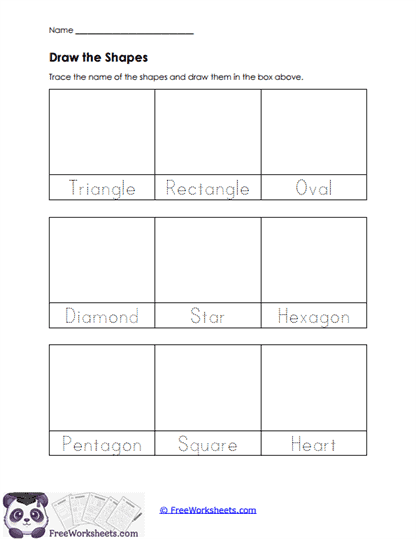
This worksheet is a Kindergarten geometry activity that helps students practice drawing and identifying common 2D shapes. Children trace shape names and then draw the matching shapes inside large boxes above the words. The activity strengthens shape recognition, handwriting, and fine motor skills while encouraging students to create shapes independently. For example, students read the word triangle and then draw a triangle in the box above it. The open drawing spaces help young learners practice forming shapes with confidence.
Curriculum and Grade Alignment
This worksheet is intended for Kindergarten students learning how to identify and create basic 2D shapes. The main learning goal is helping children connect shape names to visual representations through drawing practice. Students should already know the names of common shapes before beginning the activity. These foundational geometry skills prepare learners for future work with shape attributes, drawing, and geometry vocabulary in later grades. This worksheet supports Common Core Standard K.G.A.2 and aligns with TEKS K.6.A for identifying and describing two-dimensional shapes.
Student Tasks
On this worksheet, students will trace shape names and draw the matching shapes inside the boxes provided. Children create shapes such as triangles, rectangles, ovals, diamonds, stars, hexagons, pentagons, squares, and hearts. Learners practice geometry vocabulary while strengthening fine motor control and shape formation skills. Students also improve handwriting by tracing the dotted shape names carefully. The repeated drawing practice helps children become more comfortable creating shapes independently.
Common Challenges and Misconceptions
Some students may confuse shapes with many sides, such as pentagons and hexagons. Young learners sometimes focus more on drawing neatly than forming the correct number of sides or corners. A few children may struggle to connect the written shape name to the correct picture in their mind. Students who are still developing fine motor skills may also need extra support drawing straight lines and corners. Teachers and parents can help by modeling each shape and discussing its features before students begin drawing.
Implementation Guidance
Teachers can use this worksheet during geometry lessons, independent practice, or handwriting and drawing centers. Parents may find the drawing format helpful because it combines shape learning with creative practice during home lessons. Students can trace shapes in the air or with their finger before drawing them inside the boxes. This worksheet also works well as preparation for shape construction activities using manipulatives or art materials. Adults should encourage learners to count sides and corners while checking their drawings.
Details and Features
This printable worksheet includes large drawing boxes and several traceable shape names for guided geometry practice. Wide spaces support Kindergarten students who are still building confidence with drawing and pencil control. The black-and-white format prints clearly for classroom packets, homeschool instruction, or homework assignments. Simple organization helps children focus on one shape at a time while practicing geometry vocabulary. Its beginner-friendly design makes the worksheet useful for review, intervention, or early shape assessments.