
About This Worksheet
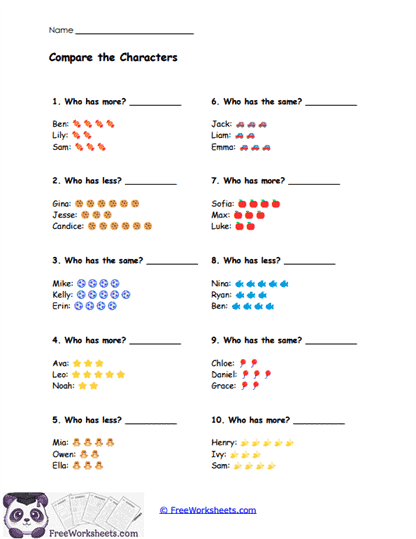
This worksheet is a Kindergarten comparison activity that helps students compare groups and identify who has more, less, or the same amount. Children read simple character-based problems and count picture sets connected to different names. The activity strengthens counting, comparison vocabulary, and number sense using familiar visual groups and easy-to-read formats. For example, if Ava has 3 stars and Leo has 5 stars, then Leo has more. The character theme helps young learners stay interested while practicing important early math concepts.
Curriculum and Grade Alignment
This worksheet is intended for Kindergarten students learning how to compare quantities within 10. The main learning goal is helping children use counting skills to compare groups and describe relationships using words like more, less, and same. Students should already know how to count objects accurately and recognize numbers before completing the activity. These comparison skills prepare learners for future work with greater than, less than, and equal to symbols in later grades. This worksheet supports Common Core Standard K.CC.C.6 and aligns with TEKS K.2.D for comparing sets and communicating quantity relationships.
Student Tasks
On this worksheet, students will compare picture groups connected to different characters and decide who has more, less, or the same amount. Children count the pictures beside each name before writing the correct answer on the line provided. Learners practice comparison vocabulary while strengthening counting fluency and visual analysis skills. Students also build reading comprehension as they follow directions and interpret simple character scenarios. The repeated problem format helps children become more confident with comparing groups independently.
Common Challenges and Misconceptions
Some students may confuse the words more and less when reading the questions. Young learners sometimes forget to count carefully and instead guess based on the size of the picture groups. A few children may compare only two names even when three characters are shown in the problem. Students who are still developing reading skills may also struggle to follow the written directions independently. Teachers and parents can help by encouraging children to count each group aloud before choosing an answer.
Implementation Guidance
Teachers can use this worksheet during math centers, comparison lessons, or independent practice sessions. Parents may use the page during homeschool instruction or short review activities at home to strengthen comparison vocabulary and counting accuracy. Students can use counters or drawings to model each character’s group before answering the question. This worksheet also works well for partner discussions where children explain why one character has more, less, or the same amount. Adults should encourage learners to double-check their counting before writing answers.
Details and Features
This printable worksheet includes ten character-based comparison problems using quantities up to 10. Large text and organized spacing support Kindergarten students who are still developing reading and writing confidence. The black-and-white design prints clearly for classroom packets, intervention groups, or homework assignments. Familiar visual groups help children focus on comparison concepts without unnecessary distractions. Its beginner-friendly structure makes the worksheet useful for review practice, assessments, or guided instruction.