
About This Worksheet
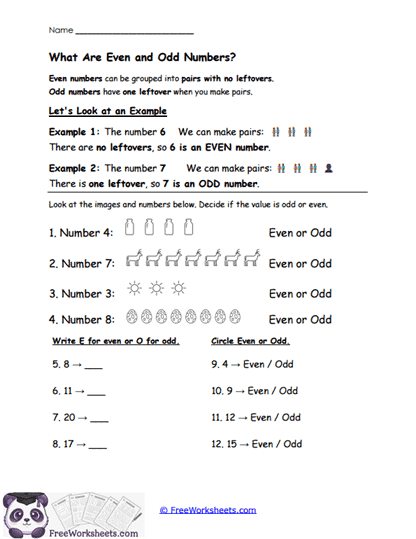
This worksheet is a Grade 2 math activity that introduces students to even and odd numbers using pictures, pairing examples, and simple number practice. Children learn that even numbers can be split into pairs with no leftovers, while odd numbers always have one leftover item. The activity uses visual examples to help students understand the difference between the two number types in a simple and clear way. For example, the number 6 can be grouped evenly into pairs, while 7 leaves one object without a partner. The combination of pictures and numbers helps students connect counting skills to number patterns.
Curriculum and Grade Alignment
This worksheet is designed for second grade students learning to identify and classify even and odd numbers. The primary learning goal is helping children understand how numbers can be grouped into pairs and recognize patterns in even and odd numbers. Students should already know how to count objects and recognize numbers up to at least 20 before beginning the activity. These foundational number skills prepare learners for future work with multiplication, division, skip counting, and number patterns. This worksheet supports Common Core Standard 2.OA.C.3 and aligns with TEKS 2.7.A for determining whether a number up to 20 is even or odd.
Student Tasks
On this worksheet, students will look at pictures and numbers to decide whether each value is even or odd. Children study visual groups, count objects, and determine if the groups can be paired evenly. Learners also write the letters E or O and circle whether certain numbers are even or odd. Students practice number classification while strengthening counting and reasoning skills. The repeated examples help children recognize patterns between even and odd numbers more quickly.
Common Challenges and Misconceptions
Some students may confuse even and odd numbers because they focus only on the number itself instead of checking for equal pairs. Young learners sometimes forget that odd numbers always have one leftover item. A few children may miscount the objects shown in the picture groups. Students who are still developing number fluency may also struggle to recognize even and odd patterns quickly. Teachers and parents can help by modeling how to pair objects together before deciding whether a number is even or odd.
Implementation Guidance
Teachers can use this worksheet during number pattern lessons, guided math groups, or introductory even-and-odd activities in second grade classrooms. Parents may find the picture examples especially helpful because they make the even-and-odd concept easier to understand during home learning sessions. Students can use counters, cubes, or drawings to create matching pairs while solving the problems. This worksheet also works well as preparation for skip counting and multiplication lessons. Adults should encourage learners to explain why a number is even or odd instead of simply guessing.
Details and Features
This printable worksheet includes picture-based examples, number classification activities, and simple even-and-odd practice problems. Large visuals and organized sections support second grade students who are still building confidence with number patterns. The black-and-white design prints clearly for classroom lessons, homework assignments, or homeschool instruction. Simple explanations and repeated practice help learners focus on understanding even and odd numbers. Its beginner-friendly structure makes the worksheet useful for review, intervention, or early number-pattern assessments.