
About This Worksheet
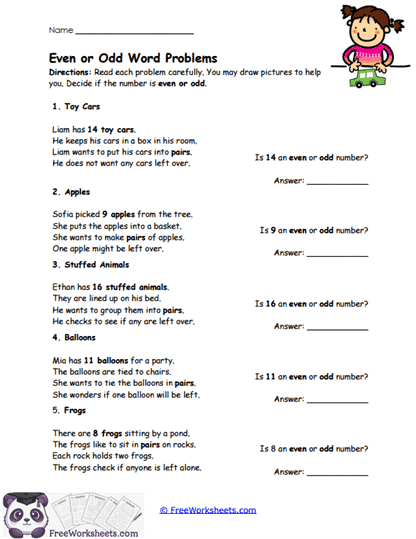
This worksheet is a Grade 2 math activity that helps students apply even-and-odd number skills to real-world word problems. Children read short stories about objects such as toy cars, apples, stuffed animals, balloons, and frogs, then decide whether the number in the story is even or odd. The activity strengthens reading comprehension, number reasoning, and understanding of equal pairs. For example, students decide whether 14 toy cars can be grouped evenly without leftovers. The story-based format helps learners connect math concepts to everyday situations.
Curriculum and Grade Alignment
This worksheet is intended for second grade students learning how to identify and explain even and odd numbers in real-life contexts. The main learning goal is helping children recognize whether a number can be split into equal groups without leftovers. Students should already know how to count objects and recognize even-and-odd patterns before completing the worksheet. These foundational math skills support future work with multiplication, division, and equal-group reasoning. This worksheet supports Common Core Standard 2.OA.C.3 and aligns with TEKS 2.7.A for determining whether numbers are even or odd.
Student Tasks
On this worksheet, students will read short word problems and decide whether each number is even or odd. Children use clues from the stories to think about pairing objects equally. Learners practice number classification while strengthening reading comprehension and reasoning skills. Students also build confidence explaining why certain numbers are even or odd in real-world situations. The repeated word-problem format helps children connect number patterns to everyday experiences.
Common Challenges and Misconceptions
Some students may focus more on the story details than the number being classified. Young learners sometimes forget that odd numbers always leave one item without a partner. A few children may struggle to picture equal groups while reading the problem. Students who are still developing reading fluency may also need support understanding the vocabulary in the stories. Teachers and parents can help by encouraging children to draw pictures or use counters to model each problem.
Implementation Guidance
Teachers can use this worksheet during even-and-odd lessons, guided math groups, or independent reading-and-math practice sessions. Parents may find the story format especially helpful because it encourages children to think about math in everyday situations during home learning. Students can underline the important number in each story before solving the problem. This worksheet also works well as preparation for multiplication and equal-group lessons in later grades. Adults should encourage learners to explain how they decided whether the number was even or odd.
Details and Features
This printable worksheet includes several beginner-friendly word problems focused on even-and-odd number reasoning. Large text and organized layouts support second grade students who are still building reading and problem-solving confidence. The black-and-white design prints clearly for classroom packets, homework assignments, or homeschool instruction. Real-world story themes help keep children engaged while practicing math concepts. Its structured format makes the worksheet useful for review practice, intervention, or even-and-odd assessments.