
About This Worksheet
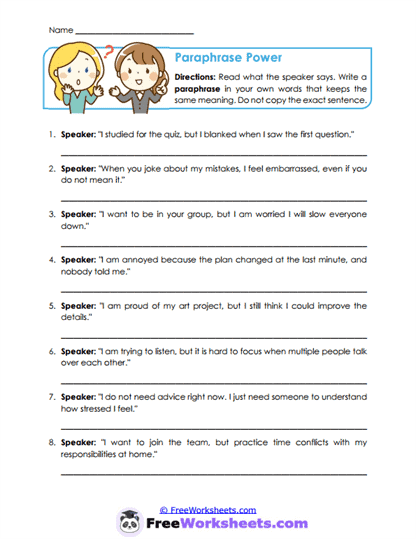
This worksheet is a paraphrasing exercise that teaches students how to restate ideas in their own words while keeping the original meaning. It focuses on communication and comprehension skills within social-emotional learning. Students read statements and rewrite them without copying the exact wording. For example, “I studied but forgot everything” becomes “I prepared, but I could not remember the answers.” This strengthens both listening and expressive language skills.
Curriculum and Grade Alignment
This activity is designed for grades 5 through 8 and emphasizes understanding and restating information. The main learning goal is to improve comprehension and respectful communication. Students should already be able to identify main ideas before attempting paraphrasing. It aligns with CCSS.ELA-LITERACY.SL.6.2, which focuses on interpreting and explaining information. TEKS 110.7(b)(6) also supports summarizing and paraphrasing skills.
Student Tasks
On this worksheet, students will read short speaker statements and rewrite them using their own words. They must keep the meaning the same while changing the structure and vocabulary. Each response requires careful thinking about tone and intent. Students will practice avoiding direct copying while still being accurate. The activity promotes deeper understanding of what the speaker is truly saying.
Common Challenges and Misconceptions
Students may simply swap a few words instead of fully rephrasing the sentence. Some might accidentally change the meaning while trying to simplify the statement. Others may struggle with emotional statements that require careful interpretation. There can also be confusion between summarizing and paraphrasing. Teachers should demonstrate examples and guide students through practice together.
Implementation Guidance
This worksheet works well during lessons on communication, reading comprehension, or conflict resolution. Teachers can model paraphrasing aloud before students begin independently. It can also be used in pairs where students compare and discuss responses. At home, parents can use it to build listening skills during conversations. This activity is especially helpful before group discussions or presentations.
Details and Features
The worksheet provides clear directions and multiple real-life statements for practice. It is formatted for easy printing and classroom use. The structure supports both independent work and guided instruction. The examples reflect common student experiences, making it relatable. It can be reused as practice for both SEL and literacy instruction.