
About This Worksheet
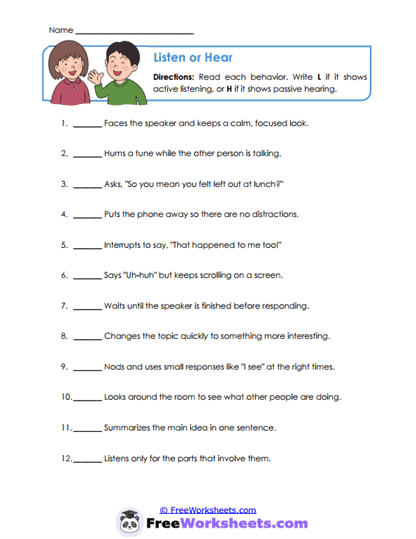
This worksheet is an active listening identification activity that helps students distinguish between true listening and passive hearing. It focuses on social-emotional learning skills typically developed in upper elementary and middle school grades. Students analyze behaviors and decide whether they demonstrate focused attention and engagement. For example, looking at the speaker becomes active listening, while looking around the room becomes passive hearing. This builds awareness of communication habits in real-life conversations.
Curriculum and Grade Alignment
This worksheet is appropriate for grades 4 through 7 and targets communication and self-awareness skills. The primary goal is to help students recognize behaviors that support effective listening. Students should already understand basic conversational norms before completing this task. This aligns with CASEL SEL competencies and supports CCSS.SL.4.1, which focuses on collaborative discussions. In Texas, it connects to TEKS 110.6(b)(1) related to listening and speaking skills.
Student Tasks
On this worksheet, students will read a list of behaviors and decide whether each one shows active listening or not. They must label each statement carefully based on their understanding of attentive communication. Some responses require recognizing subtle differences between polite behavior and true engagement. Learners will evaluate actions like interrupting, summarizing, or maintaining eye contact. The task encourages thoughtful reflection on everyday listening habits.
Common Challenges and Misconceptions
Students may confuse polite responses like “uh-huh” with actual listening, even when attention is divided. Some may think being quiet automatically means they are listening, which is not always true. Others might struggle to identify distractions such as phone use as barriers to listening. The difference between hearing words and understanding meaning can also be unclear. Teachers should model examples and discuss why certain behaviors show deeper engagement.
Implementation Guidance
Teachers can use this worksheet as an introduction to a lesson on communication skills or classroom expectations. It works well as a quick check for understanding during SEL units. In small groups, students can discuss their answers and explain their reasoning. Parents can use it at home to talk about respectful communication during conversations. This activity also pairs well with role-playing exercises to reinforce learning.
Details and Features
The worksheet includes clearly written directions and a structured list of behaviors for easy completion. It is formatted for simple printing and can be used as a one-page activity. The design supports independent or guided practice. Visual elements help engage students without overwhelming the content. It is suitable for both classroom and homeschool environments.