
About This Worksheet
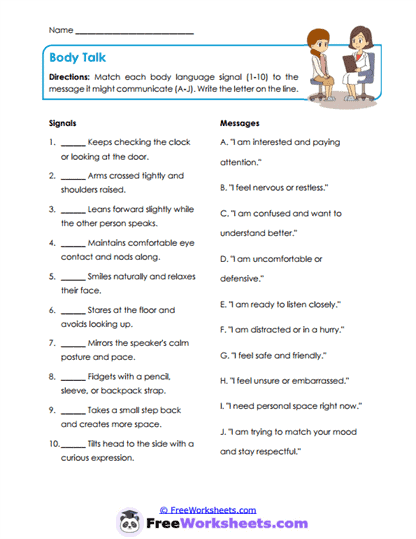
This worksheet is a body language interpretation activity that helps students understand nonverbal communication cues. It focuses on recognizing how physical actions can express thoughts and emotions during conversations. Students match different body signals with the message they likely communicate. For example, crossing arms tightly becomes feeling defensive, while leaning forward becomes showing interest. This strengthens awareness of both personal and social communication behaviors.
Curriculum and Grade Alignment
This worksheet is designed for grades 4 through 7 and supports social-emotional learning and communication skills. The primary goal is to help students interpret nonverbal cues accurately. Students should already have basic knowledge of emotions and interpersonal interactions. It aligns with CCSS.SL.5.1, which focuses on engaging effectively in discussions. In Texas, it connects to TEKS 110.6(b)(1) related to listening and speaking behaviors.
Student Tasks
On this worksheet, students will match each body language signal with the message it most likely communicates. They must carefully analyze each action and consider what it might mean in a conversation. Some matches require distinguishing between similar emotions like nervousness and distraction. Learners will use reasoning to connect physical cues to emotional intent. The activity builds awareness of how body language supports communication.
Common Challenges and Misconceptions
Students may assume one body signal always means the same thing in every situation. Some might confuse similar cues, such as looking away being distraction instead of discomfort. Others may rely on personal interpretation without considering context. There can also be difficulty understanding subtle signals like mirroring behavior. Teachers should discuss multiple meanings and provide real-life examples to clarify.
Implementation Guidance
Teachers can use this worksheet during lessons on communication, empathy, or social awareness. It works well as a discussion starter before role-playing activities. Students can act out signals to deepen understanding. At home, parents can use it to talk about body language during daily interactions. This activity helps students become more mindful communicators.
Details and Features
The worksheet includes a matching format with clearly labeled signals and messages. It is designed for easy printing and classroom use. The layout supports visual scanning and organized responses. Engaging illustrations help students connect with the content. It can be used independently or as part of guided instruction.