
About This Worksheet
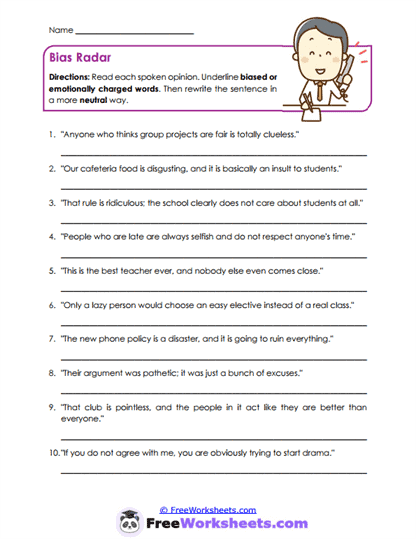
This worksheet is a bias detection and rewriting activity that helps students recognize emotionally charged language. It focuses on identifying biased words and rewriting statements in a more neutral way. Students read opinions and adjust the language to make it fair and balanced. For example, “This is the worst rule ever” becomes “I disagree with this rule because it feels unfair.” This builds critical thinking and respectful communication skills.
Curriculum and Grade Alignment
This worksheet is appropriate for grades 6 through 8 and supports analytical thinking and communication skills. The primary goal is to help students identify bias and practice neutral language. Students should already understand opinion versus fact before completing this task. It aligns with CCSS.ELA-LITERACY.RI.7.8, which focuses on evaluating arguments and claims. In Texas, it connects to TEKS 110.7(b)(9) related to analyzing persuasive texts.
Student Tasks
On this worksheet, students will read opinion-based statements and underline biased or emotionally strong words. They will then rewrite each sentence to make it more neutral and balanced. Each task requires careful attention to tone and wording. Students must think about how language affects meaning and perception. The activity encourages thoughtful revision and respectful expression.
Common Challenges and Misconceptions
Students may struggle to identify subtle bias that is not overly obvious. Some might remove strong words but still keep the same biased tone. Others may rewrite sentences without maintaining the original meaning. There can also be confusion between neutral language and simply shortening a sentence. Teachers should model examples and guide students through the rewriting process.
Implementation Guidance
Teachers can use this worksheet during lessons on media literacy, argument analysis, or respectful communication. It works well as a partner activity where students compare revisions. Group discussions can help highlight different ways to neutralize language. At home, parents can use it to discuss fairness in everyday conversations. This activity supports both academic and social communication skills.
Details and Features
The worksheet includes clear directions and ten opinion-based statements for analysis. It is formatted as a one-page printable for easy classroom use. The structure allows space for both identifying bias and rewriting sentences. The content reflects real-world opinions that students can relate to. It is suitable for independent or guided practice.