
About This Worksheet
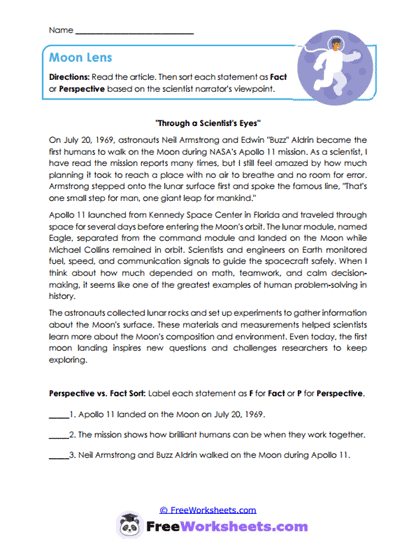
This worksheet is a reading comprehension activity that focuses on distinguishing between fact and perspective in informational text. It helps students understand how an author’s viewpoint can shape how information is presented. In grade 7 science and ELA integration, this skill builds critical thinking about historical events and scientific writing. Students read about the moon landing and evaluate statements based on evidence versus interpretation. For example, a date like July 20, 1969 is a fact, while calling the mission “one of the greatest achievements” reflects perspective.
Curriculum and Grade Alignment
This worksheet is designed for 7th grade students working on identifying fact versus opinion and understanding author’s perspective. The main goal is to help students analyze how information can be presented objectively or with interpretation. Students should already know how to identify basic facts before completing this activity. The next step is evaluating bias and credibility in more complex texts. It aligns with Common Core standard CCSS.ELA-LITERACY.RI.7.6 and TEKS 7.10(E).
Student Tasks
On this worksheet, students will read an informational passage about the Apollo 11 moon landing. They will then sort given statements into fact or perspective categories. Students must carefully analyze each statement and refer back to the text for support. They will determine whether each idea is directly proven or shaped by the author’s interpretation. This requires close reading and thoughtful reasoning.
Common Challenges and Misconceptions
Students may confuse strong opinions with facts if the language sounds convincing. Some might assume all statements in an informational text are factual without questioning tone or wording. Others may struggle to justify their choices with evidence from the passage. It is also common for students to overlook subtle opinion words like “greatest” or “amazing.” Teachers can support learning by modeling how to spot opinion clues in language.
Implementation Guidance
Teachers can use this worksheet during a unit on informational text or scientific literacy. It works well as a bridge between reading comprehension and critical analysis. Parents can guide students by discussing the difference between facts and opinions in everyday conversations. This activity can also be used as a quick assessment or review before tests. Encourage students to explain why they labeled each statement as fact or perspective.
Details and Features
This worksheet includes a well-written passage about a historical scientific event. It provides clear directions and structured response space for sorting statements. The design is simple and printable for easy classroom use. It encourages both reading comprehension and analytical thinking. The content connects science and literacy skills in an engaging way.