
About This Worksheet
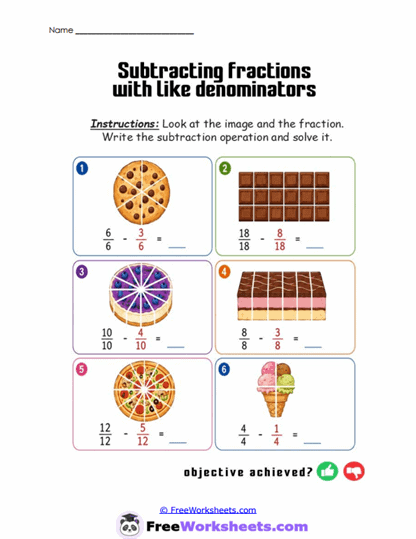
Fraction Food Minus is a fourth grade visual activity that gives students more practice subtracting fractions with the same denominator. Each problem pairs a food picture with a fraction subtraction equation so students can connect the numbers with equal-sized parts of a whole. For example, 6/6 − 3/6 means starting with six sixths and removing three sixths, leaving 3/6. The cookie, chocolate, cake, pizza, and ice cream pictures make the subtraction easier to picture while students practice the written rule.
Curriculum and Grade Alignment
This worksheet is made for fourth grade learners who are strengthening their understanding of subtracting fractions with like denominators. The main goal is to help students see that the denominator stays the same while the numerators are subtracted. Before using this page, your child should understand how a numerator and denominator describe equal parts of a whole. The next step is solving the same types of fraction subtraction problems without visual support. This activity supports fraction models, subtraction, numerator reasoning, and visual math skills.
Student Tasks
Students will solve six fraction subtraction problems. Each one includes a familiar food divided into equal portions and a corresponding equation. The problems use denominators such as fourths, sixths, eighths, tenths, twelfths, and eighteenths. Students subtract the second numerator from the first and write the remaining fraction on the line. The pictures provide a helpful check for each answer.
Common Challenges and Misconceptions
Some students may subtract both the numerators and denominators. Others may write the fraction that was removed instead of the fraction that remains. A child may also be distracted by the picture and forget to use the written equation. Encourage your child to say the problem aloud, such as “six sixths minus three sixths.” This reinforces that the fractional pieces keep the same name while only the number of pieces changes.
Implementation Guidance
Teachers can use this worksheet as continued visual practice before moving to fully numerical fraction subtraction. It works well for independent work, centers, or homework. Parents can ask the child to identify how many equal pieces the whole has, then count how many are being taken away. After solving, compare the written answer with the model. This helps build confidence and accuracy.
Details and Features
This worksheet includes six colorful food-based fraction subtraction problems arranged in a two-column grid. Each problem shows a visual model, a like-denominator subtraction equation, and a blank for the answer. The denominators vary across several common fraction sizes. The printable supports fraction subtraction, visual modeling, numerator fluency, and fraction sense.