
About This Worksheet
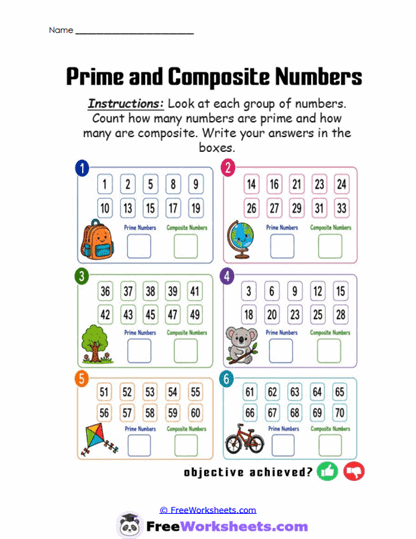
Factor Tally Challenge is a fourth grade activity that combines prime-and-composite classification with careful counting. Each box presents a mixed group of ten numbers, and students determine how many values have exactly two factors and how many have more than two. The groups include numbers from different ranges, so children must apply factor reasoning instead of memorizing one short list of primes. This gives students useful practice checking numbers systematically.
Curriculum and Grade Alignment
This worksheet is intended for fourth grade learners who are becoming more confident with prime and composite numbers. The main goal is to help students use factor knowledge to classify and tally larger groups accurately. Before beginning, your child should know common multiplication facts and be able to find basic factor pairs. The next step is using primes and composites in factorization and common-factor work. This activity supports factor fluency, divisibility, classification, and number patterns.
Student Tasks
Students will examine six sets of ten numbers. The groups include values such as 1, 2, 5, 8, 9, 10, 13, 15, 17, 19 and other sets extending into the 60s and 70s. Students classify each usable value, then record the total number of prime and composite numbers in the spaces provided. This requires careful attention because values such as 1 do not fit either category and should not be treated as prime or composite.
Common Challenges and Misconceptions
Some students may incorrectly call 1 a prime number. Others may classify every even number as composite and forget that 2 is prime. A child may also mistake numbers such as 27, 39, or 51 for primes because they are odd. Encourage your child to remember that 1 is neither prime nor composite and that 2 is the only even prime. For larger odd values, test common divisors before deciding.
Implementation Guidance
Teachers can use this worksheet as a deeper review because students must handle both standard examples and the special case of 1. It works well for discussing why not every whole number belongs in the prime or composite categories. Parents can have the child circle prime numbers, underline composites, and leave 1 unmarked. Then count each category separately. This makes the classification visually clear.
Details and Features
This worksheet includes six illustrated groups of ten numbers with spaces to record Prime Numbers and Composite Numbers totals. The values range from 1 into the 70s and include several useful examples for discussing divisibility and the special status of 1. The printable supports factors, number classification, divisibility, and tallying.